


09 Jun 2026

When construction begins, most homeowners focus on layout, design, and visible finishes. Material decisions happen alongside the work, and cement is often treated as a standard purchase—something that can be selected quickly based on availability or a familiar brand.
The issue is that this decision does not show its impact immediately. The structure may look fine during construction, but with the passing of time, cracks, weak bonding, and durability problems start to appear. In many cases, these issues trace back to how cement was selected in the early stages.
This is a clear sign that you have used random cement and not the best cement for construction. The type, grade, and condition of cement used at each stage influence how well the structure performs over the years.
This blog explains the common mistakes made while selecting the best cement for house construction and what should be done instead to ensure reliable, long-term performance.
Cement Selection: The Deciding Factor Behind Structural Strength
Cement selection defines how effectively concrete develops strength and durability under actual service conditions. In structural elements such as footings, columns, and slabs, the cement grade must align with the design strength.
Any mismatch would result in lower compressive strength development, which compromises load-bearing capacity and increases the likelihood of microcracking under stress.
The type of cement influences the hydration process and heat evolution. High early-strength cements such as OPC 53 generate higher heat during hydration, which can induce thermal gradients in larger sections and lead to internal cracking. In contrast, blended cements such as PPC moderate heat generation and refine pore structure.
The water-cement ratio remains a controlling parameter for strength and permeability. Even a marginal increase in water content dilutes the cement matrix, leading to higher porosity and reduced density.
In slabs, it affects shrinkage control and crack resistance. In plastering and finishing, it determines workability and surface integrity.
Selecting the appropriate cement type and grade for each stage ensures controlled strength development, structural stability, and long-term performance without premature deterioration.
7 Misconceptions to Avoid When Selecting Cement for House Construction
Mistake #1: Selecting Cement Based Only on Brand Name
When we start a house construction project, one of the first decisions we make is choosing a cement brand. Most of us tend to go with a familiar or popular name, assuming that a good brand automatically means the right choice.
But this is where we go wrong.
A brand can assure consistency and quality control, but it does not decide whether the cement is suitable for your specific use. You might be using the right brand but the wrong type or grade for the job.
What we need to do instead is simple—first understand where the cement will be used. Is it for RCC, masonry, or plastering? Once that is clear, we select the appropriate type and grade. The brand should come in at the final stage, not the first.
Mistake #2: Ignoring Cement Grade (33, 43, 53)
We often hear that higher grade cement is better, so we assume using 53 grade everywhere is the safest option. On the surface, it sounds logical—but in practice, it creates problems.
Cement grade defines the strength it can achieve. While 53 grade cement gives higher early strength, it also generates more heat during setting. If we use it where it is not required, it can lead to shrinkage and cracks.
On the other hand, 43 grade cement offers more controlled strength development and better workability, which makes it suitable for general construction tasks like masonry and plastering.
So instead of thinking “higher is better,” we should ask—what does this part of the structure actually need?
Not sure which cement grade is right for your project? Read more about cement grades and their applications in house construction.
Mistake #3: Treating OPC and PPC as Interchangeable
Many times, we treat OPC and PPC as if they are the same and can be used anywhere. In reality, they behave very differently during construction.
If you use OPC, you get faster strength gain. This is useful when we need early strength, especially in structural work. But it also produces more heat, which increases the chances of cracks if not handled properly.
PPC works differently. It gains strength slowly but offers better durability and reduced heat of hydration. This makes it more suitable for plastering, masonry, and areas exposed to moisture or chemicals.
So when we switch between OPC and PPC without thinking about the application, we are unknowingly reducing the lifespan of the structure.
Mistake #4: Not Verifying Cement Freshness
This is one of those mistakes that looks small but has a direct impact on strength.
Cement does not remain the same after manufacturing. Over time, especially if exposed to moisture, it starts losing its binding properties. Even if the bag looks fine from the outside, the quality inside may already be compromised.
When we use old or partially hydrated cement, we end up needing more water, getting lower strength, and compromising durability.
Before using cement, we should always check a few basic things—the manufacturing date, the presence of lumps, and whether the texture feels smooth when rubbed.
Mistake #5: Improper Storage at Site
Even if you purchase the right cement, poor storage at the site can undo everything.
We often see cement bags placed directly on the ground or stored in areas exposed to humidity. What happens in such cases is that the cement starts reacting with moisture in the air even before it is used.
This early reaction reduces its strength and affects how well it bonds in concrete and mortar.
To avoid this, we need to store cement properly—keep it on a raised platform, cover it from moisture, and maintain some distance from walls. Also, using older bags first helps you maintain consistency in the cement quality.
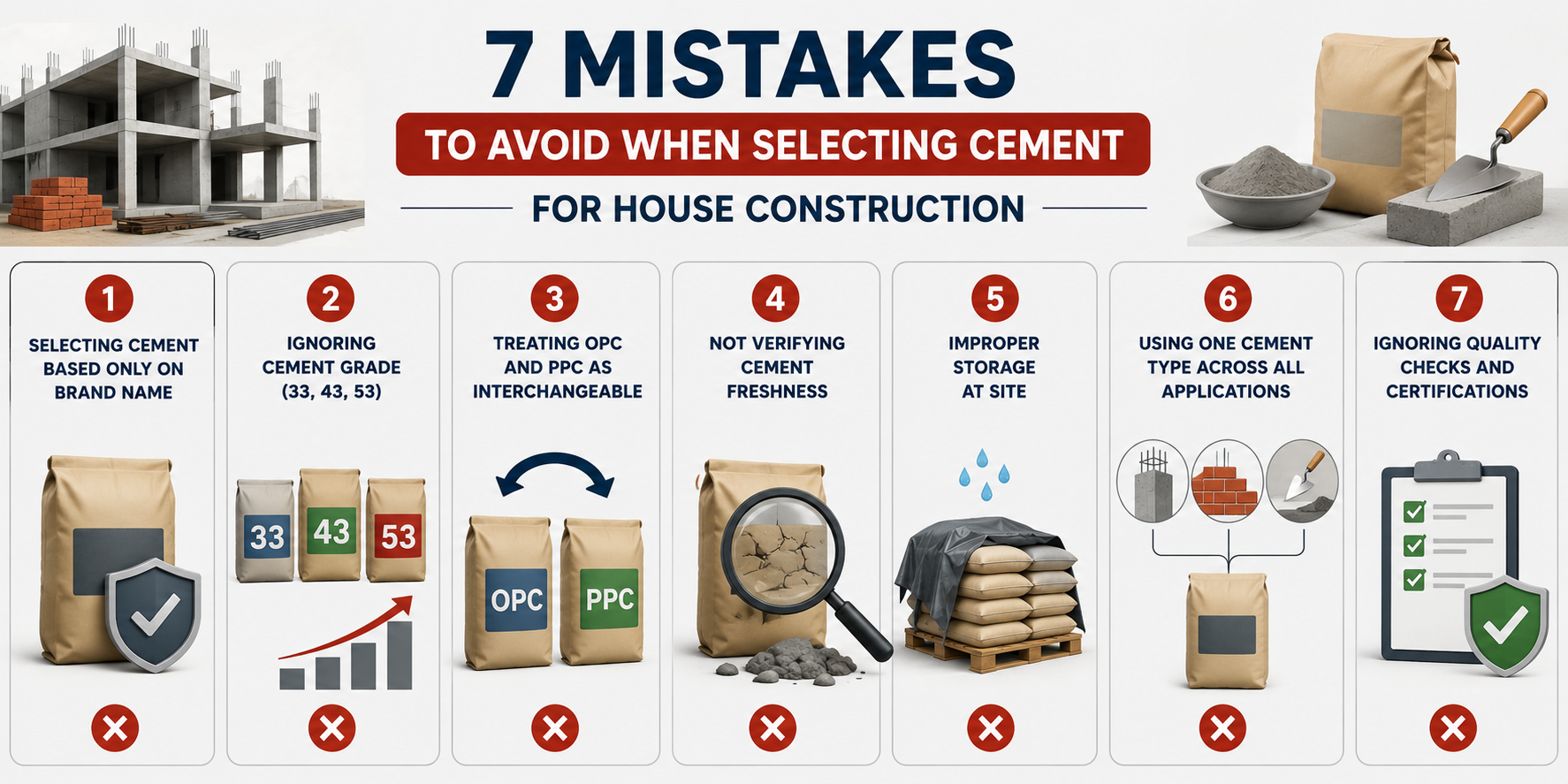
Mistake #6: Using One Cement Type Across All Applications
For convenience, we sometimes decide to use one type of cement throughout the project. It simplifies purchasing and handling, but it is not how construction works in practice.
Different parts of a house have different requirements. Structural elements need strength, masonry needs workability, and plastering needs a smooth finish with minimal cracking.
When we use the same cement everywhere, we compromise at least one of these requirements. For example, using high-strength cement in plastering can lead to cracks, while using slower-setting cement in structural work can delay strength gain.
If we want better results, we need to align the cement type with each stage of construction instead of treating it as a one-size-fits-all material.
Mistake #7: Ignoring Quality Checks and Certifications
Before using cement, there is one last step that we often overlook—verification.
We should always ensure that the cement meets the standards set by the Bureau of Indian Standards and carries a valid ISI mark. In India, different types of cement are governed by specific IS codes—for example, IS 269 for OPC 33 grade, IS 8112 for OPC 43 grade, IS 12269 for OPC 53 grade, and IS 1489 for PPC.
Apart from certification, conduct some basic checks like the cement should be free from lumps, consistent in color, and fine in texture. Any irregularity is a sign that something is not right.
Skipping these checks might save a few minutes, but it increases the risk of using material that can affect the entire structure.
Final Perspective
When we look at most construction issues related to cement, they rarely come from the material itself. They come from how we choose it, how we store it, and how we use it.
If you are aiming to select the best cement for house construction, the approach has to be structured. You should understand your requirements, selecting the right type and grade of cement, and verify quality before use. This way you can avoid most of these problems.
Frequently Asked Questions
1. Which is the best cement for house construction?
The best cement for house construction depends on the application. OPC 53 grade is generally used for structural work, while PPC is more suitable for masonry and plastering.
2. Is 53 grade cement better than 43 grade cement?
Not necessarily. 53 grade cement is used where higher early strength is required, while 43 grade cement is suitable for general construction due to its balanced performance.
3. What is the difference between OPC and PPC cement?
OPC gains strength faster and is used for structural work. PPC gains strength gradually and offers better durability, making it suitable for masonry and plastering.
4. Can I use the same cement for RCC, masonry, and plastering?
It is not recommended. Different applications require different properties, so using a single cement type can affect performance and finish quality.
5. How do I verify cement quality before use?
Check for the ISI mark as per the Bureau of Indian Standards, confirm the manufacturing date, and ensure the cement is free from lumps with a uniform texture.
Latest Posts


Popular Tags
- 43 Grade Cement
- 53 Grade Cement
- best cement
- best cement for construction
- best cement for dhalai
- Best Cement for House Construction
- best cement for plaster
- Best Cement for Plastering
- best cement for roof
- Best Cement for Roof Slab
- Best cement in Assam
- Cement factories in Assam
- cement shelf life
- cement storage during monsoon
- cement storage tips
- dhalai cement
- OPC 53 Grade
- OPC Cement
- OPC vs PPC Cement
- PPC Cement
- types of cement


