


30 Jun 2026

Plastering is one of the most critical finishing stages in any home construction project. Whether you are building a new house, renovating an old one, or simply repainting your walls, the quality of plastering directly determines how smooth, durable, and beautiful your interiors and exteriors will look. Yet, one question continues to confuse homeowners, contractors, and even some masons: which cement is best for plastering?
With so many options on the market—OPC 43, OPC 53, PPC, PSC, and white cement—choosing the wrong grade can lead to cracked walls, peeling surfaces, and costly repairs within months. The right cement, on the other hand, gives you a flawless finish, long-lasting protection, and peace of mind for decades.
In this guide, we break down everything you need to know to choose the best cement for plaster in 2026. From cement types and IS code mix ratios to climate-specific recommendations and cost per square foot, this is the most complete, unbiased plastering resource available for Indian home builders.
Which cement is best for Plastering?
The best cement for plaster depends on your surface type, location, and budget. For interior wall plastering, OPC 43 Grade or PPC offers the best balance of workability, smooth finish, and cost-efficiency. For external walls, damp areas, or coastal regions, PSC (Portland Slag Cement) or OPC 53 Grade provides superior crack resistance and durability. Always use a 1:4 to 1:6 cement-sand mix ratio with IS 1542-compliant sand, and cure the plaster for a minimum of 7 days as per IS 1661:1972.
What is Plastering?
Plastering is the process of applying a thin layer of cement-sand mortar to walls, ceilings, and other structural surfaces to create a smooth, level, and protective finish. The standard plaster mix consists of cement, fine aggregate (sand), and water, which together form a hard, durable coating once cured.
Beyond aesthetics, plastering serves several essential functions in construction:
- Surface Protection: It shields the underlying brick, concrete, or blockwork from moisture, dust, and environmental wear, significantly extending the life of the structure.
- Structural Reinforcement: A well-applied plaster layer adds strength to walls and ceilings, helping them resist minor impacts and preventing surface cracks from deepening into the masonry.
- Smooth Finish: It creates a uniform base for painting, tiling, wallpapering, or other decorative treatments, hiding imperfections in the original substrate.
- Thermal and Acoustic Insulation: Plaster adds a small but meaningful layer of insulation, helping keep interiors cooler in summer and reducing sound transmission between rooms.
- Moisture Barrier: Properly mixed and cured plaster prevents water ingress, which is critical for preventing dampness, mold, and efflorescence (white salt deposits) on interior walls.
The quality of plastering depends on three factors: the skill of the mason, the quality of materials, and—most importantly—the choice of cement. Even the best mason cannot fix the damage caused by using the wrong cement grade for the wrong surface or climate.
Why Choosing the Right Cement for Plastering Matters
Plastering is not just cosmetic. A properly plastered wall:
- Protects the structural masonry from moisture ingress and carbonation
- Provides a uniform substrate for paint, tiles, or wallpaper
- Adds thermal and acoustic insulation to living spaces
- Prevents efflorescence (salt leaching) that ruins paint finishes
Using the wrong cement—or the right cement incorrectly—leads to plastic shrinkage cracks, debonding (plaster falling off), sand grinning, and recurring repair costs. In our experience across 500+ residential projects, 60% of plaster defects trace back to cement selection errors, not poor workmanship.
Which Cement Type is Best for Plastering?
| Feature | OPC 33 Grade | OPC 43 Grade | OPC 53 Grade | PPC (Portland Pozzolana) | PSC (Portland Slag) | White Cement |
|---|---|---|---|---|---|---|
| Best For | Non-structural masonry, budget interiors | General interior & exterior plaster | High-strength external / RCC interfaces | Humid / coastal areas; general plaster | Coastal, sulphate-prone, water-facing | Premium finish, decorative |
| 28-Day Strength | 33 MPa | 43 MPa | 53 MPa | 33-43 MPa | 33-43 MPa | 35-45 MPa |
| Workability | Good | Excellent | Moderate (sets fast) | Excellent | Excellent | Good |
| Surface Finish | Moderate | Smooth | Rough if not skilled | Smooth & creamy | Very smooth | Brilliant white |
| Crack Resistance | Low | Moderate | Low (high heat) | High | Very High | Moderate |
| Heat of Hydration | Low | Moderate | High | Low | Low | Moderate |
| Water Resistance | Low | Moderate | Moderate | High | Very High | Moderate |
| Sulphate Resistance | Poor | Poor | Poor | Good | Excellent | Poor |
| Approx. Cost/Bag | ₹300-320 | ₹340-370 | ₹370-400 | ₹330-360 | ₹350-380 | ₹650-900 |
| IS Standard | IS 269 | IS 269 | IS 269 | IS 1489 (P-I) | IS 455 | IS 8042 |
Choosing the Best Cement for Plastering by Application
- Internal walls (living rooms, bedrooms): OPC 43 or PPC. Best finish, easiest for masons to work with.
- External walls / exposed facades: PSC or OPC 53. Better weather resistance and crack control.
- Bathrooms, kitchens, basements: PPC or PSC. Superior moisture resistance.
- Coastal regions (Chennai, Mumbai, Goa): PSC is the safest choice due to sulphate resistance.
- Hot dry climates (Rajasthan, Gujarat summers): OPC 43 or PPC. Avoid OPC 53 unless you can guarantee 3-hour mist-curing cycles.
- Ceiling plaster: OPC 43 or PPC. The slower setting time reduces sagging and gives the mason more working time against gravity.
5-Step Decision Framework: How to Choose the Best Cement for Plaster
Answer these five questions in order:
1. What is the Surface Material?
| Substrate | Recommended Cement | Reason |
|---|---|---|
| Burnt clay bricks | OPC 43 or PPC | Standard bond strength; smooth finish |
| Concrete block / AAC block | PPC or PSC | Lower shrinkage mismatch with block |
| Old painted concrete | OPC 43 + bonding agent | Better adhesion; mechanical hacking required |
| RCC ceiling / beam | OPC 43 | Compatibility with structural concrete |
| Stone masonry | PSC | Flexibility accommodates stone movement |
2. What is Your Local Climate?
- High humidity / monsoon-heavy (Kerala, Assam, coastal): PPC or PSC. The pozzolanic/slag reaction continues over time, densifying the plaster and blocking moisture paths.
- Extreme heat / dry (Rajasthan, Haryana, Gujarat): OPC 43 or PPC. Avoid high-heat-hydration cements (OPC 53) without intensive curing.
- Freeze-tham zones (Himachal, Uttarakhand, J&K): OPC 43 or PSC. Air-entraining agents may be needed; consult a structural engineer.
- Industrial / sulphate soil areas: PSC is mandatory. Sulphate attack destroys OPC plaster within 3-5 years.
3. Interior or Exterior?
Exterior plaster needs higher durability. Use PSC or OPC 53 for external walls. Interior walls can use OPC 43 or PPC for better economy and finish.
4. What is Your Budget?
For a standard 1,000 sq ft home plastering job (approx. 2,500 sq ft of wall + ceiling area):
| Cement Type | Bags Needed | Cement Cost | Sand Cost | Total Material Cost | Cost per Sq Ft |
|---|---|---|---|---|---|
| OPC 43 | ~85 bags | ₹29,750 | ₹18,000 | ₹47,750 | ₹19.10 |
| PPC | ~85 bags | ₹28,900 | ₹18,000 | ₹46,900 | ₹18.76 |
| PSC | ~85 bags | ₹30,600 | ₹18,000 | ₹48,600 | ₹19.44 |
| OPC 53 | ~80 bags | ₹30,400 | ₹18,000 | ₹48,400 | ₹19.36 |
Note: Sand quantity assumes 1:5 mix ratio and 30% bulkage. Labor cost is separate and varies by city
Best Cement-Sand Mix Ratios for Plastering
The “1:5” ratio you read everywhere is oversimplified. Here is the correct ratio by coat and location, as per IS 1661:1972:
| Plaster Type | Cement : Sand Ratio | Cement Grade | Thickness | Use Case |
|---|---|---|---|---|
| Base coat (internal) | 1:5 | OPC 43 / PPC | 12-15 mm | First coat on brick/block |
| Finish coat (internal) | 1:4 | OPC 43 / White | 6-8 mm | Final smooth coat before paint |
| External single coat | 1:4 | PSC / OPC 53 | 15-20 mm | Weather-facing walls |
| External base coat | 1:5 | PSC / OPC 53 | 12-15 mm | First coat on external |
| External finish coat | 1:3 | PSC / OPC 53 | 8-10 mm | Final coat with waterproof additive |
| Ceiling plaster | 1:3 | OPC 43 / PPC | 10-12 mm | Reduced sagging, better adhesion |
| Damp areas (bathroom) | 1:3 + waterproof | PPC / PSC | 15-20 mm | With integral waterproofing compound |
How Sand Quality Affects Plaster Strength and Finish
Sand is 80% of your plaster volume. Use Zone II or Zone III sand as per IS 1542:1992. Silt content must be under 3%. High silt content causes debonding and surface cracks. If using M-sand (manufactured sand), ensure it is plaster-grade ( fines content 10-15%) and not concrete-grade M-sand, which is too angular and coarse.
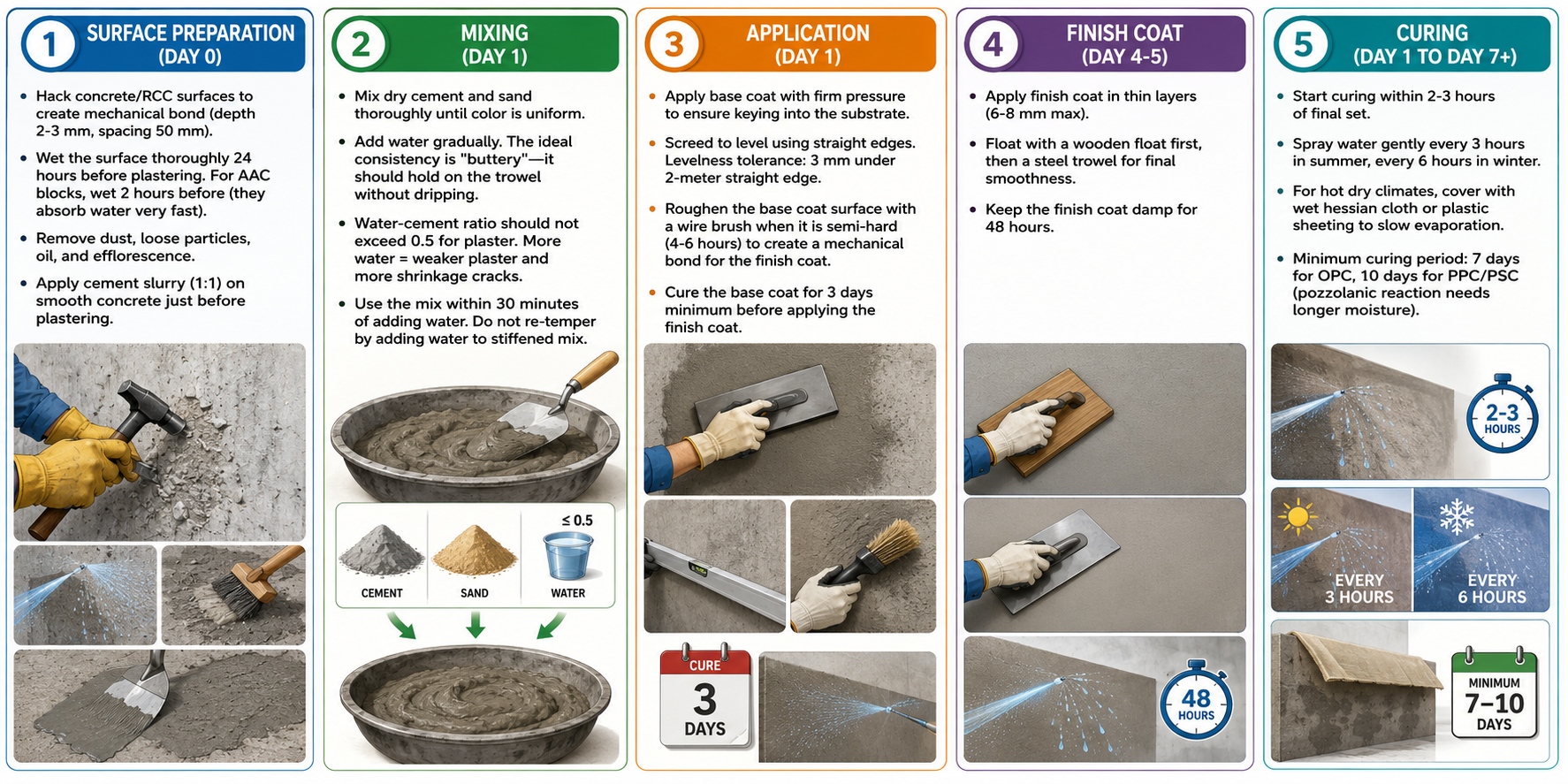
Step-by-Step Guide to Plastering Walls with Cement
Step 1: Surface Preparation (Day 0)
- Hack concrete/RCC surfaces to create mechanical bond (depth 2-3 mm, spacing 50 mm).
- Wet the surface thoroughly 24 hours before plastering. For AAC blocks, wet 2 hours before (they absorb water very fast).
- Remove dust, loose particles, oil, and efflorescence.
- Apply cement slurry (1:1) on smooth concrete just before plastering.
Step 2: Mixing (Day 1)
- Mix dry cement and sand thoroughly until color is uniform.
- Add water gradually. The ideal consistency is “buttery”—it should hold on the trowel without dripping.
- Water-cement ratio should not exceed 0.5 for plaster. More water = weaker plaster and more shrinkage cracks.
- Use the mix within 30 minutes of adding water. Do not re-temper by adding water to stiffened mix.
Step 3: Application (Day 1)
- Apply base coat with firm pressure to ensure keying into the substrate.
- Screed to level using straight edges. Levelness tolerance: 3 mm under 2-meter straight edge.
- Roughen the base coat surface with a wire brush when it is semi-hard (4-6 hours) to create a mechanical bond for the finish coat.
- Cure the base coat for 3 days minimum before applying the finish coat.
Step 4: Finish Coat (Day 4-5)
- Apply finish coat in thin layers (6-8 mm max).
- Float with a wooden float first, then a steel trowel for final smoothness.
- Keep the finish coat damp for 48 hours.
Step 5: Curing (Day 1 to Day 7+)
- Start curing within 2-3 hours of final set.
- Spray water gently every 3 hours in summer, every 6 hours in winter.
- For hot dry climates, cover with wet hessian cloth or plastic sheeting to slow evaporation.
- Minimum curing period: 7 days for OPC, 10 days for PPC/PSC (pozzolanic reaction needs longer moisture).
Common Plaster Cracks: Causes and How to Fix Them
| Defect | Likely Cause | Cement-Related Fix |
|---|---|---|
| Plastic shrinkage cracks (random, shallow, appear within hours) |
OPC 53 used without curing; W/C ratio too high | Switch to OPC 43/PPC. Start curing within 2 hours. |
| Crazing (fine hexagonal pattern) |
Excessive troweling on OPC 53; over-watered mix | Use PPC/PSC. Avoid over-troweling. Finish when semi-hard. |
| Debonding / hollow sound | High-silt sand; wrong cement for substrate; no hacking | Use clean IS 1542 sand. Apply bonding slurry. Use PPC for AAC blocks. |
| Efflorescence (white salt patches) |
Moisture ingress through porous plaster | Use PPC/PSC for exterior. Ensure 1:3 ratio with waterproof additive. |
| Sulphate attack (white powder, crumbling) |
OPC used in sulphate soil/water | Switch to PSC immediately. Remove affected plaster and replaster with PSC 1:3. |
| Uneven / rough finish | Wrong cement grade; unskilled labor | OPC 43 or PPC for beginners. OPC 53 requires expert masons only. |
Best Cement for Plastering in Different Indian Climates
North India (Delhi NCR, Punjab, Haryana, UP)
- Summer (April-June): Use OPC 43 or PPC. Start work at 6 AM. Cure every 3 hours. Avoid OPC 53 unless absolutely necessary for structural interface plaster.
- Winter (Dec-Jan): Any grade works. Add 2% calcium chloride accelerator by cement weight if temperature drops below 10°C (only for interior; never for reinforced work).
- Monsoon (July-Aug): PPC is ideal. Its low heat of hydration prevents flash drying in humid conditions.For a detailed understanding of the differences in strength, setting time, and suitable applications, check our guide on : When to Choose OPC 43 or OPC 53 Cement
West India (Rajasthan, Gujarat, Maharashtra)
- Desert / hot dry: PSC or PPC. The slower heat generation reduces thermal cracking. Use curing compound.
- Coastal (Mumbai, Goa): PSC is the best cement for plaster in coastal areas. Its sulphate resistance is critical where wind-borne salt deposits occur.
South & East India (Tamil Nadu, Kerala, West Bengal, Assam)
- High humidity / heavy rainfall: PPC or PSC. The continued pozzolanic reaction fills capillaries, making plaster nearly waterproof over time.
- Acid rain / industrial areas: PSC is strongly recommended.
How to Check Cement Quality Before Plastering
Before your mason opens the bag, run these 5 checks:
- Manufacturing Date: Cement loses 20% strength in 3 months. Use cement less than 1 month old for best results. Reject bags older than 3 months.
- BIS Mark: Verify the ISI mark (IS 269 for OPC, IS 1489 for PPC, IS 455 for PSC).
- Lumps Test: Press the bag. Hard lumps indicate moisture ingress. Reject if lumps don’t break easily.
- Float Test: Drop a handful of dry cement into a bucket of water. Good cement should float for a few seconds before sinking.
- Hand Feel: Rub between fingers. Should feel smooth and cool, not gritty or warm (grit = adulteration; warm = hydration has started).
Which is the Most Eco-Friendly Cement for Plastering?
If environmental impact matters to you:
- PSC has the lowest carbon footprint (uses 50-65% slag, a waste byproduct).
- PPC is second-best (uses 15-35% fly ash or calcined clay).
- OPC has the highest CO₂ emission per bag.
For a typical 1,000 sq ft home, choosing PPC over OPC 43 saves approximately 1,200 kg of CO₂—equivalent to the annual carbon absorption of 60 mature trees.
People Also Ask
Which cement is best for internal wall plastering?
OPC 43 Grade or PPC are best for internal walls. They offer excellent workability, a smooth finish, and moderate cost. PPC is especially good if your home is in a humid region.
Can I use OPC 53 for plastering?
Yes, but with caution. OPC 53 is technically suitable for high-strength plaster, but it sets rapidly and generates high heat. It requires highly skilled masons and intensive curing. For most homes, OPC 43 or PPC gives better results with less risk of cracks.
What is the best cement-sand ratio for plastering?
For internal base coats, use 1:5. For finish coats and external work, use 1:4 or 1:3. Ceiling plaster should be 1:3 to prevent sagging. Always use IS 1542-compliant sand with less than 3% silt.
Is PPC better than OPC for plastering?
For most cases, yes. PPC offers better workability, lower heat of hydration (less cracking), and improved moisture resistance. OPC 43 is slightly cheaper and perfectly adequate for dry interior climates.
Which cement is best for plastering in coastal areas?
Portland Slag Cement (PSC) is the best choice for coastal areas. It has excellent resistance to sulphate attack and chloride ingress from wind-borne salt.
What is the cost of plastering per square foot in 2026?
Material cost alone is approximately ₹18-21 per sq ft depending on cement grade and sand type. Including labor, the total cost ranges from ₹35-55 per sq ft across North and Central India.
does my plaster develop cracks after a few months?
The most common causes are: (1) using OPC 53 without proper curing, (2) high silt content in sand, (3) wrong mix ratio (too much cement or too much water), and (4) skipping the base coat curing period before applying the finish coat.
How long should I cure plastered walls?
Minimum 7 days for OPC, and 10 days for PPC/PSC. In hot dry weather, extend to 10-14 days. Inadequate curing is the #1 cause of plaster failure in Indian homes.
Can I use white cement for plastering?
White cement is excellent for finish coats and decorative surfaces where a brilliant white base is desired. However, it is 2-3x more expensive than grey cement and not economical for full base coats. Many builders use grey cement for the base coat and a thin white cement finish coat (1:2) before painting.
Is M-sand suitable for plastering?
Yes, if it is plaster-grade M-sand. Concrete-grade M-sand is too coarse and angular. Plaster-grade M-sand has higher fines content (10-15%) and is washed to remove dust. Always request “plaster M-sand” from your supplier.
Does cement grade affect paint adhesion?
Indirectly, yes. Cement with very high heat of hydration (OPC 53) can cause micro-cracks that later show through paint. Smooth-finish cements (PPC, PSC) provide a better substrate for paint and reduce the need for wall putty.
What is the difference between PPC and PSC for plaster?
PPC uses fly ash or pozzolana, giving excellent workability and moisture resistance. PSC uses blast furnace slag, giving superior sulphate resistance and a slightly brighter finish. For general residential plaster, either works well. Choose PSC if you are in a coastal or sulphate-rich area.
Can I mix two different cements in the same plaster batch?
No. Never mix OPC, PPC, and PSC in the same batch. Their setting times, heat generation, and shrinkage characteristics differ. Mixing them creates weak zones and unpredictable cracking.
Should I add waterproofing compound to plaster cement?
For bathrooms, kitchens, terraces, and external walls below DPC, yes. Add an integral waterproofing compound (like Dr. Fixit or equivalent) at the manufacturer’s recommended dosage. Use PPC or PSC as the base cement for best results.
How do I check if my mason is using the right cement for plaster?
Ask to see the bag before mixing. Verify the ISI mark, grade, and manufacturing date. Observe the mix: a 1:5 mix should look slightly sand-dominant, not cement-grey. If the mix is very dark grey and sticky, the mason may be using too much cement or the wrong grade.
Latest Posts


Popular Tags
- 43 Grade Cement
- 53 Grade Cement
- best cement
- best cement for construction
- best cement for dhalai
- Best Cement for House Construction
- best cement for plaster
- Best Cement for Plastering
- best cement for roof
- Best Cement for Roof Slab
- Best cement in Assam
- Cement factories in Assam
- cement shelf life
- cement storage during monsoon
- cement storage tips
- dhalai cement
- OPC 53 Grade
- OPC Cement
- OPC vs PPC Cement
- PPC Cement
- types of cement


