


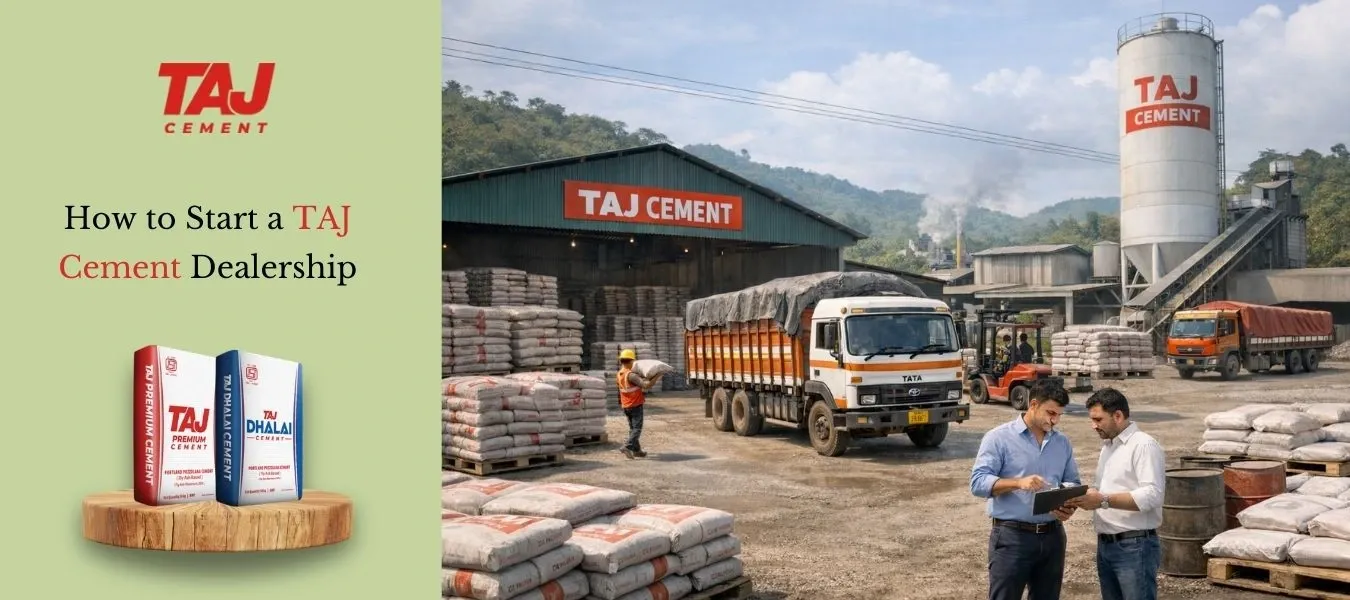
23 Feb 2026

Summary: This guide provides a complete overview of the requirements, eligibility criteria, investment readiness, and business considerations needed before applying for a TAJ Cement dealership, helping prospective distributors make informed decisions. It enables serious applicants to assess their preparedness, streamline the approval process, and confidently move forward with dealership registration.
In modern construction projects, cement is an irreplaceable raw material. Report suggests that in the Indian Cement market, blended cement led with 71.62% revenue share in 2025. With the growing construction industry in India, owning a cement dealership can be a profitable investment.
However, which cement manufacturing company you choose can influence your profit merging. If you already trust TAJ Cement and are considering becoming a dealer, this guide is for you.
We will help you understand what you should sort out before applying for the TAJ Cement Dealership. Being prepared saves time. It also makes discussions smoother.
About TAJ Cement
TAJ Cement operates under Hills Cement Company Limited and has a strong footprint across Meghalaya, Assam, and other Northeastern states.
Founded in 2009, the brand runs a 200-acre integrated manufacturing plant at Mynkree village in Meghalaya. With a wide authorised dealer network, TAJ Cement supplies both residential and commercial projects across major cities in the Northeast.
If you’re here, chances are you already know the product. What you need now is clarity on the business side.
Who should consider a TAJ Cement dealership?
This opportunity suits people who:
- Already trade in building materials.
- Have strong local contractor or builder contacts.
- Understand regional construction demand.
- Can manage stock, credit cycles, and logistics.
If you’re completely new to trading, it’s better to spend some time understanding local demand first.
Become part of our distribution networks by filling out a simple form:
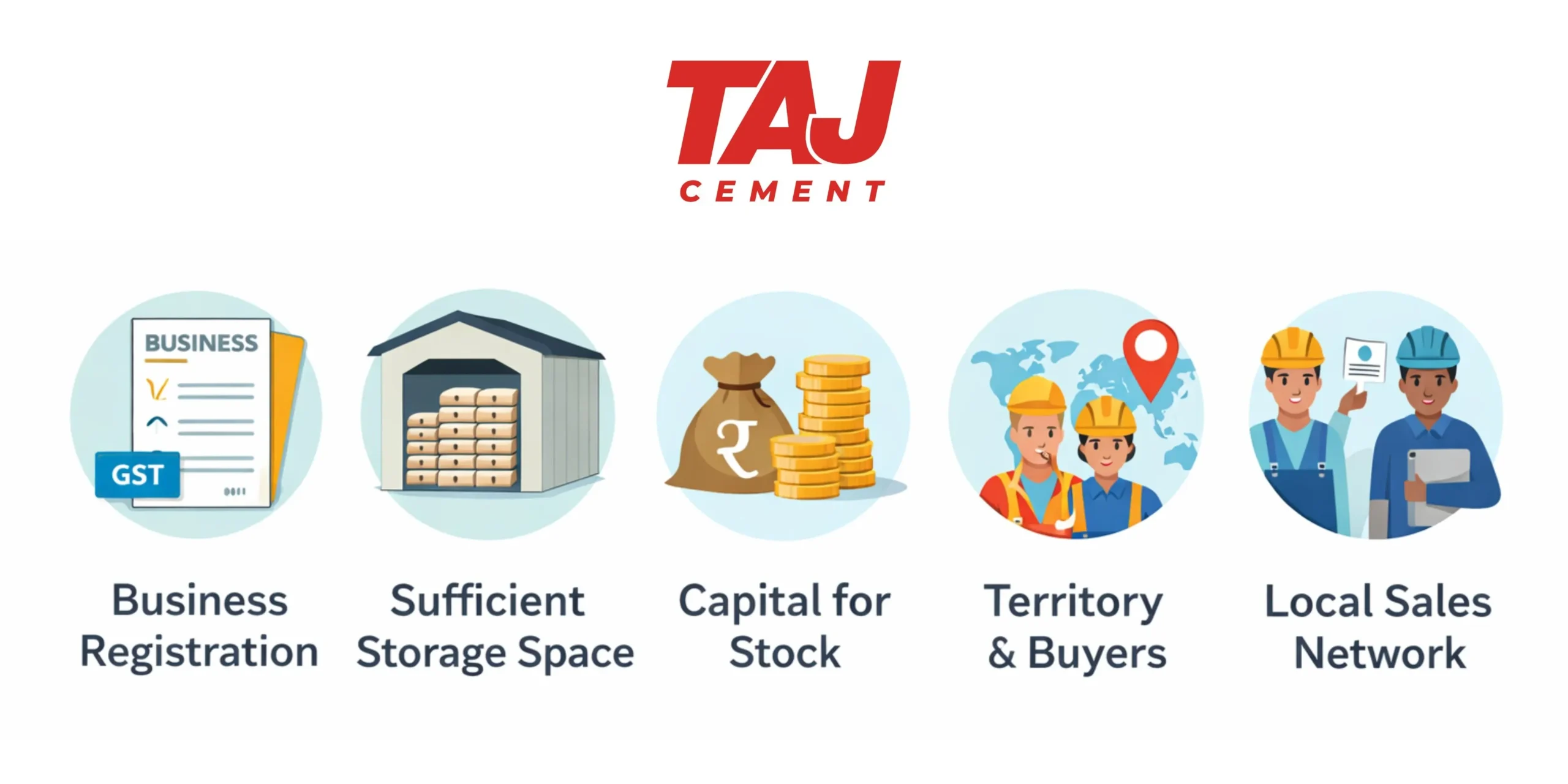
Things to get ready before contacting TAJ Cement
If you have made up your mind to take our distributorship, here are few things you should prepare:
-
Business registration & basic documents
Before you reach out, ensure your business is legally set up.
Keep these ready:
- GST registration.
- Firm registration (proprietorship, partnership, or company).
- PAN and address proof.
- Bank account linked to the business.
Most cement manufacturers ask for these early in the discussion. And keeping them ready will speed up the process.
-
Storage space & location clarity
Cement is a hygroscopic material, which basically means it absorbs water. Even humidity or moisture can impact the store. So, you need to store the cements in dry, covered storage. Even a small dealership needs proper space.
Think about:
- Minimum 400–500 sq ft for initial stocking.
- Easy truck access for loading and unloading.
- Protection from moisture and rain.
You don’t need a showroom. A godown works fine if it’s accessible.
-
Working capital planning
Cement is a volume business. Margins are steady, but you might not see it instantly.
Prepare funds for:
- Initial stock purchase.
- Transportation costs.
- Labour and handling.
- GST flows until payments settle.
It helps if you can manage at least one full stock cycle without stress.
-
Territory & market understanding
TAJ Cement works through authorised dealers. This means area clarity matters.
Before contacting them, ask yourself:
- Which town or district will I serve?
- Who are my main buyers, contractors, builders, or retailers?
- Is there steady construction activity in this area?
A clear territory plan shows seriousness.
-
Sales network & local connections
Dealerships don’t run on walk-ins alone.
Make a simple list of:
- Local contractors and masons.
- Builders and developers.
- Hardware stores and sub-dealers.
Even 10–15 strong contacts can kickstart monthly movement.
How the dealership discussion usually works
While exact terms vary, the usual process looks like this:
- You submit an enquiry through TAJ Cement’s official channel.
- The sales team reviews your location and documents.
- They might visit your space or ask for proof.
- Ask you about expected monthly volumes.
- You may also need to provide details on storage and logistics.
- If approved, commercial terms are shared.
- Agreement and onboarding begin.
Common mistakes to avoid
While owning a cement distributorship is a straightforward process, people often make mistakes. Here are some common mistakes:
- Contact without GST or documents.
- No storage plan in place.
- Unrealistic sales expectations.
- Ignoring transport logistics.
- Treating it as a short-term side business.
Cement rewards consistency, not shortcuts.
Final checklist before you reach out
Before contacting TAJ Cement, make sure you can answer:
- Do I have a registered business and GST?
- Where will I store cement safely?
- How much stock can I move monthly?
- Who will I sell to first?
- How will deliveries be managed?
If these are clear, you’re ready for the next step.
Closing note
Owning a TAJ Cement dealership is not complicated. However, you should check your local demands and supply chain before the final call. If you already know your market and have the basics in place, the process becomes straightforward.
FAQs
Who can apply for a TAJ Cement dealership?
Anyone with a registered business, GST, storage space, working capital, and strong local construction market connections can apply.
Is prior experience in cement or construction mandatory?
Not mandatory. However, experience in building materials or local contractor networks makes operations smoother and sales faster.
What documents are required to apply for a TAJ Cement dealership?
During the initial evaluation, here are a few documents usually needed: GST certificate, firm registration, PAN, address proof, and a business-linked bank account.
How much storage space is needed for a dealership?
You need a minimum of 400–500 sq ft of dry, covered storage with proper ventilation, and easy truck access is recommended.
Do I need a showroom to become a dealer?
No. A godown or warehouse works fine, as long as cement is stored safely and logistics are convenient.
How much investment is required to start a TAJ Cement dealership?
Investment varies by location and volume, covering initial stock, transport, labour, and working capital for one stock cycle.
Categories
- All (8)
- AAC Block (1)
- Building (3)
- Cement (4)
- Cement dealership (1)
- Construction (2)
- Market (3)
Latest Posts
-
February 21, 2026
How to Start a TAJ Cement Dealership
-
January 31, 2026
Best Cement for Roof & RCC in Rainy & Humid Climates
-
January 29, 2026
Impact of Soil Type & Rainfall on Cement Strength


