


15 Jun 2026

In most construction projects, cement selection is commonly based on grade, brand reputation, and procurement timing. Once delivered to site, it is often assumed that the material will retain its original properties until it is used. However, this assumption does not always hold true under practical site conditions.
In regions such as Assam, where climatic conditions include high humidity and frequent rainfall, storage environments are rarely completely dry. Construction activities may also face interruptions due to weather or scheduling constraints, resulting in cement being stored for extended periods. During this time, even when bags are properly stacked and covered, the material remains exposed to moisture present in the surrounding air.
This exposure leads to gradual changes in the cement.
Although these changes may not be immediately visible, they gradually affect the cement’s chemical properties and performance. But does the same apply even to the best cement for construction?
Let’s find out.
What is the Shelf Life of Cement?
Cement is hygroscopic in nature, meaning it has a tendency to absorb moisture from the atmosphere. This initiates partial hydration before actual use, which reduces its reactivity during mixing.
As a result, cement that has been stored for longer durations may not perform in accordance with its specified grade. This can affect bonding, strength development, and overall durability of the concrete.
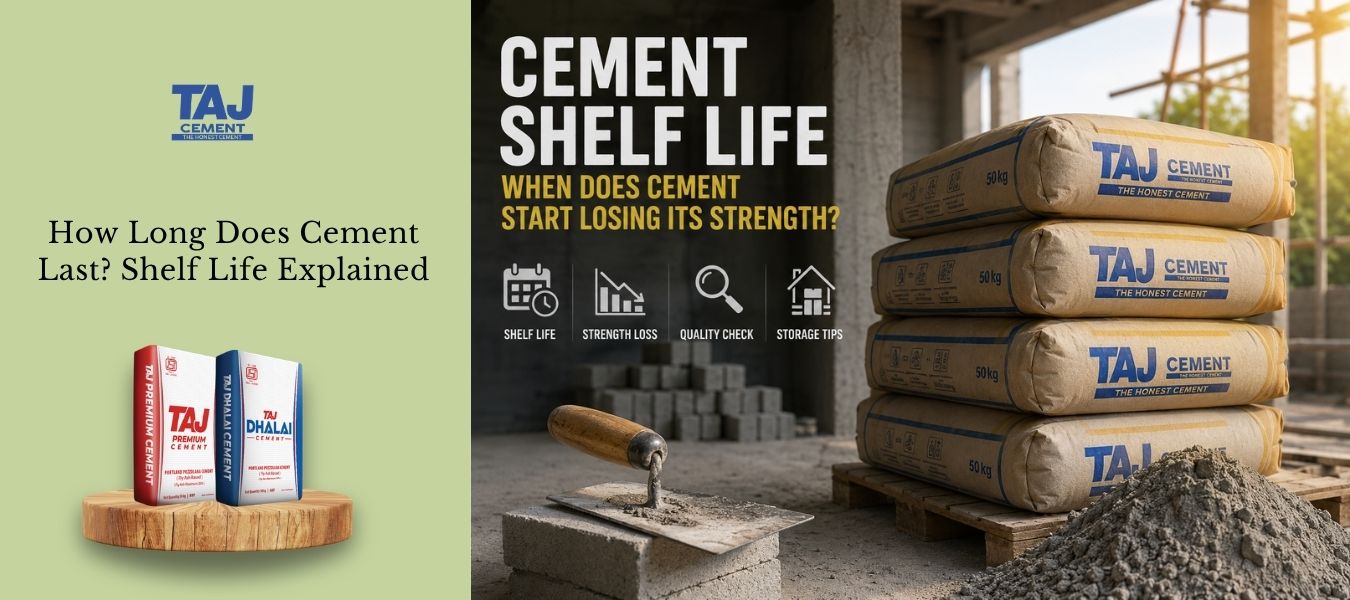
Cement does not come with a fixed expiry date; however, it has a practical usage window within which it delivers its intended performance. Under normal storage conditions, cement should ideally be used within 90 days (3 months) from the date of manufacture to achieve its designed strength and performance.
After this period, the cement does not become unusable, but its strength characteristics begin to change. The rate of deterioration depends on storage conditions, especially exposure to moisture.
For example, a higher-grade cement may not achieve its designed compressive strength if it has been stored for an extended period.
Why Even The Best Cement Starts Losing Its Strength?
Cement begins to react with moisture in the air even before it is used. This process, known as pre-hydration, causes:
- Formation of small lumps
- Reduction in bonding capacity
- Lower reactivity during mixing
These changes reduce the effectiveness of cement in forming strong and durable concrete
Moreover, the loss in strength is gradual and depends on storage conditions as well:
- After 3 months → slight reduction in strength
- After 6 months → noticeable decline in performance
- After 12 months → significant loss of reliability, depending on storage conditions
This is particularly critical for load-bearing structures.
How to Check Cement Quality Before Use
Even when cement is sourced from a trusted brand or considered the best cement for construction, its condition at the time of use matters just as much as its grade. Since deterioration is gradual and not always visible, it becomes important to verify cement quality before mixing.
Here are simple, practical checks that can be done directly on-site:
Visual Inspection
Start with a basic visual check of the cement bag and its contents.
Fresh cement should appear smooth and uniform in color (typically grey with a slight greenish shade). If you notice hard lumps inside the bag, it indicates that the cement has already started reacting with moisture.
Small lumps that break easily may still be usable for non-structural work. However, cement with large, hardened lumps should be avoided, especially for load-bearing applications.
Touch Test
Take a small quantity of cement and rub it between your fingers.
Good quality cement feels smooth and fine. If it feels gritty or coarse, it may have been exposed to moisture or mixed with impurities. This directly affects how well it will bind with other materials during mixing.
Temperature Check
Insert your hand into the cement bag.
Fresh cement typically feels cool to the touch. If it feels warm, it may indicate ongoing internal reactions due to moisture exposure. This is often a sign that the cement has begun to lose its original properties.
Float Test
Take a handful of cement and sprinkle it over a bucket of water.
Fresh cement should initially float on the water surface before gradually sinking. Immediate sinking may indicate moisture absorption or reduced quality. If it sinks immediately, it may indicate reduced quality due to premature hydration.
Date of Manufacture
Always check the manufacturing date printed on the cement bag.
As discussed earlier, cement performs best within 90 days from the date of manufacture. While it may still be usable beyond this period, its strength characteristics may not remain consistent.
Best Practices to Store Cement Properly on Site
Proper storage plays a critical role in preserving cement quality between procurement and use. Since cement begins to lose its effectiveness with time, controlled storage conditions can help slow down this deterioration and maintain performance within its usable period.
On-site storage should follow a few essential practices:
- Store cement on raised wooden pallets.
- Keep stacks at least 300 mm away from walls.
- Cover with waterproof tarpaulin.
- Store in a dry, well-ventilated enclosed area.
- Follow the FIFO (First In, First Out) method.
Additionally, follow a First In, First Out (FIFO) approach so that older stock is used before newer deliveries, reducing the risk of prolonged storage.
What Happens If Expired Cement Is Used?
Using cement beyond its shelf life can have a negative impact on the quality and durability of construction.
The most immediate effect is a reduction in compressive strength, which affects the load-bearing capacity of concrete. This may not always be visible during initial stages but can lead to structural concerns.
Bonding performance also declines, weakening the adhesion between cement and aggregates. This can result in surface defects, cracks, or poor finishing in plastering and concrete work.
Cement that has exceeded its ideal usage period is not always completely unusable, but its application becomes limited.
In cases where cement has been stored properly and shows no signs of lump formation, it may still be used for non-structural work such as:
- Base layers for flooring
- Temporary construction
- Minor repair work
Before using older cement, basic quality checks should always be performed to assess its condition. Even when using the best cement for construction, performance depends on how well its properties have been preserved.
Final Thoughts
Cement performance is not determined solely by its grade or brand. While selecting the best cement for construction is important, its effectiveness depends equally on how it is stored, handled, and used.
Even the best cement can underperform if it is not preserved properly before use. Small oversights in storage or delays in usage can gradually reduce its strength, affecting the overall quality and durability of the structure.
So, always avoid prolonged storage and poor handling, as these factors can weaken the base of the structure and affect its long-term stability.
Frequently Asked Questions
What is the shelf life of cement?
Cement works best when used within about 90 days from its manufacturing date. After that, it doesn’t suddenly go bad, but its strength can slowly reduce—especially if it hasn’t been stored properly.
Can cement be used after 6 months?
Yes, but with caution. If the cement is still in good condition (no lumps, no signs of moisture), it can be used for small, non-structural work. For anything structural, it’s safer to use fresh cement.
Does cement expire in the bag?
Cement doesn’t come with a strict expiry date, but it doesn’t stay the same forever either. Even inside a bag, it can slowly absorb moisture from the air and lose its inherent strength.
Can old cement be reused?
Old cement can still be used, but only for minor, non-structural work like small repairs or temporary applications. For any construction that requires strength and long-term durability, it’s safer to use fresh cement.
Should I buy cement in bulk or as needed?
It’s better to procure cement as per requirement, since prolonged storage can lead to gradual strength loss due to moisture exposure and reduced reactivity.
Latest Posts
-
-

-
June 15, 2026
Different Types of Cement Used in House Construction


