


11 Feb 2026

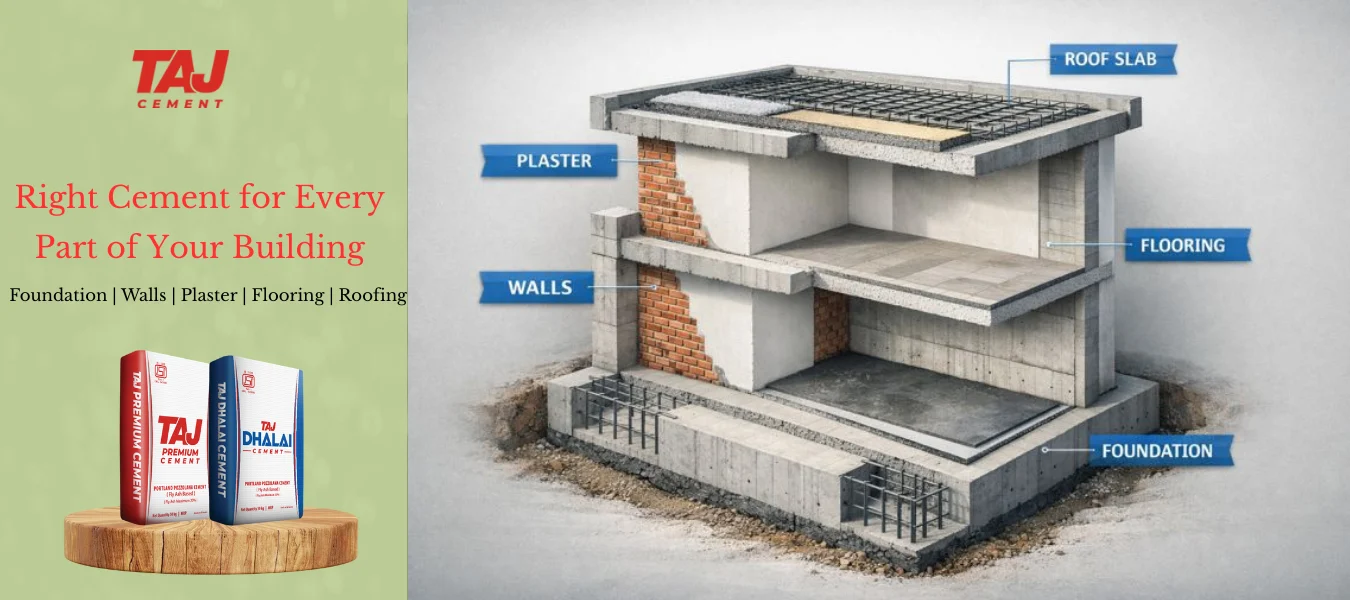
Cement is an essential construction material for any project. But that doesn’t mean you can use the same cement for every part of the structure. Every building owner wants to use the best cement for construction. But building a project, whether it is residential or commercial, includes foundation, wall plastering, flooring, and roofing.
However, for many residential and small commercial projects, the same cement is used for every job. This often ends up influencing the long-term performance of the building. Even though choosing one type of cement is convenient, different construction stages demand different properties. For instance, foundations need strength and durability. You need a cement for the wall that has high bonding and workability. Plastering cements need fineness and finish. Flooring must resist wear, even with high foot traffic. And last but not least, you need a cement with controlled setting and crack resistance for the roof.
This article breaks down the different types of cement, so you can choose the right cement for each job. We will share practical explanations, real-site considerations, and which specific Taj Cement products fit naturally into each stage:
How Does Cement Work in Construction
Let’s first understand how cement works. Cement is a binding agent. When you mix it with water and aggregates like sand and gravel, it hardens. This makes concrete stronger and durable to withstand the external environment.
When you consider the best cement for construction, it is not just the strength. There are other properties as well that influence how cement behaves once it reaches the site, such as:
- Compressive strength defines how much load concrete can withstand.
- Setting time means how long masons have to place and finish work.
- Workability influences flow, leveling, and surface quality.
- Durability indicates how well the concrete resists moisture, chemicals, and time.
During construction, roofing, flooring, plastering, etc., each has a different role. The right cement balances these properties based on the job at hand. A cement that performs well in a slab may not deliver the finish needed for plaster. Similarly, you can’t choose a cement only because it gains strength fast, as it can cause cracks later.
Understanding Cement Type Based on Application
Here we will be categorizing the cement types based on their application. We will also discuss what properties the cement should have, so you take the right decision.
Best Cement for Foundations
Here, strength is the priority. Foundations carry the entire weight of the structure. The structures are constantly in touch with moisture, soil chemicals, and fluctuating groundwater levels.
What to look for in foundation cement
- High compressive strength
- Stable hydration behavior
- Resistance to moisture-related deterioration
- Compatibility with reinforcement
Which Taj Cement Works Well
For most residential and low-rise commercial foundations, we recommend a cement with balanced strength and controlled setting.
Taj Dhalai Cement is preferred by many contractors. It is manufactured with Advanced Cement Dispersion (ACD) technology, waterproofing, and anticorrosion properties, offering consistent performance. Taj OPC 53 grade cement also offers excellent performance.
Best Site Practices when Using Dhalai Cement
- Maintain proper water–cement ratio.
- Ensure vibration and compaction.
- Cure for at least 7–14 days, longer in hot weather.
Best Cement for Walls and Structural Members
When you are applying cement on walls, columns, and beams, bonding strength and workability is as important as compressive strength. Because if the cement mix won’t flow or settle properly, it can lead to voids, poor bonding, honeycombing, uneven surfaces, and cracks. The structure becomes weak and might not offer durability in the long-term.
Recommended Taj Cement for Walls and Beams
Taj OPC 43 Grade Cement & Taj OPC 53 Grade Cement are good choices for wall construction and general structural work. The OPC 43 grade offers early strength gains in concrete up to M30 grade with a minimum compressive strength of 43 MPa. OPC 53 grade, on the other hand, offers 53 MPa compressive strength at 28 days. The cements support structural integrity where design loads are higher, especially in multi-storey construction.
Practical tips when working with cement for walls and beams
- Avoid overly stiff mortar mixes.
- Keep joints consistent.
- Allow adequate curing before loading.
Best Cement for Plastering
Plaster should not just look good or feel smooth. It should also be durable. Otherwise, you have to deal with plaster peeling off or dampness.
Which Taj Cement Is Ideal
Taj Premium Cement offers smoother surfaces that look and feel great. It also reduces the chances of hairline cracking when cured properly.
Best Practices for Plastering
Plastering fails mostly because of poor finish behavior or rushed curing.
- Use clean, well-graded sand.
- Stick to recommended mix ratios.
- Protect fresh plaster from rapid drying.
Best Cement for Flooring
Since flooring surfaces usually have to withstand foot traffic, impact loads, and even moisture ingress, it is better to choose a cement that offers both hardness and stability.
Suitable choices
For screeds and leveling layers, Taj Premium Cement offers a good balance between flow and strength, helping achieve flatter surfaces with fewer corrections.
On-site considerations
- Proper vibration and leveling
- Joint planning for large areas
- Consistent curing to prevent dusting
Best Cement for Roofing and Slab Work
Roof slabs withstand temperature fluctuations, direct sun exposure, and long-term moisture stress. Thus, choosing the right cement influences cracking and durability.
Roofing challenges
- Thermal expansion and contraction
- Early loading during construction
- Long-term weather exposure
Recommended options
Both Taj Dhalai Cement & Taj OPC 53 grade work well for slab casting, where controlled setting and good workability are required. It allows proper placement and finishing without rushing the pour. If you are on a tight schedule and want to gain strength faster, jOPC 53 Grade Cement is often selected, with strict curing practices to manage shrinkage risks.
Execution tips
- Avoid adding excess water.
- Make sure to properly cover the reinforcement.
- Maintain curing even after de-shuttering.
Quick Overview of Taj Cement Types and Grades
Before finalizing cement for any job, it helps to clearly understand grades and where each Taj product fits.
| Product | Strength | Workability | Ideal for | Key Benefit |
| Taj Dhalai Cement | High | Good | Foundation, Roof Slabs | Balanced early strength |
| Taj Premium Cement | Medium-High | Very High | Plaster & Finish | Smooth finishing, less cracks |
| Taj OPC 43 | Solid | Good | Walls, Beams, Columns | Reliable all-rounder |
| Taj OPC 53 | Very High | Moderate | Heavy loads, roofing, beams and walls with proper conditioning | High compressive strength |
Final Thoughts
When it comes to the best cement for construction, sadly, there is no one-size-fits-all. Contractors usually recommend a mix of different types of cement for different tasks. While it may seem a bit hassling, choosing the different types of cement for roofing, flooring, foundation, and plastering increases the long-term durability of your building.
FAQs
1. Which cement is best for roofing?
The best cement for roof slabs, especially in the north-eastern states of India, is Taj Dhalai Cement or Taj OPC 53 Grade. Both offer controlled settings, good workability, and high strength, helping reduce cracks caused by heat, load, and long-term weather exposure.
2. What is the best cement for plastering?
Taj Premium Cement is the best cement for plastering. Especially in states like Assam and Meghalaya with heavy rainfall, it offers high finesse and resistance to dampness.
3. Which type of cement is best for foundation?
For foundations in states that have a long monsoon, Taj Dhalai Cement works the best. It has balanced strength that improves load-bearing capacity. In addition, the waterproofing and anticorrosion properties reduce maintenance costs and durability.
4. Which cement is good for flooring?
In humid climates, Taj Premium Cement works well when used for flooring. It offers good flow, surface stability, and strength. So, even with heavy traffic or high load, you don’t have to worry about wear or cracks.
5. Which cement is best for walls?
We recommend Taj OPC 43 Grade Cement. It has good bonding strength and workability, and reduces the risk of weak joints and surface cracks.
6. What is the best cement for beams and columns?
When constructing beams and columns, structural strength is important. Taj OPC 53 Grade Cement is best for beams and columns.
Categories
- All (8)
- AAC Block (1)
- Building (3)
- Cement (4)
- Cement dealership (1)
- Construction (2)
- Market (3)
Latest Posts
-

February 21, 2026
How to Start a TAJ Cement Dealership
-
January 31, 2026
Best Cement for Roof & RCC in Rainy & Humid Climates
-
January 29, 2026
Impact of Soil Type & Rainfall on Cement Strength


