


26 Jun 2026

Every contractor has faced this situation on-site at some point. A roof slab is cast properly, the reinforcement placement looks accurate, vibration is done carefully, and the finishing work appears clean and level. The concrete seems strong in the first few days. Then, slowly, small surface cracks begin to appear. After a few months, seepage marks show up during heavy rain, or the slab starts showing signs of early surface weakness.
Most discussions then revolve around cement quality, mix proportion, or workmanship during dhalai. But in many cases, the actual problem begins after the concrete pouring is completed.
On many construction sites, teams give maximum attention to the casting process but treat curing as a routine follow-up activity. Watering becomes irregular after a few days, slab ponding is stopped early, or vertical surfaces receive very little curing attention. The structure may look hard from the outside. As a result, this affects compressive strength, increases porosity, and creates conditions for cracks and long-term durability issues.
That is why curing plays such an important role in concrete construction. Even when contractors use the best cement for dhalai, poor curing can weaken the final foundation of the structure.
What Curing Means in Concrete Construction
Curing is the process of maintaining adequate moisture and temperature in concrete after placement so that cement hydration can continue properly.
After dhalai, cement particles react with water and gradually form a binding structure inside the concrete. This process does not finish within a few hours after casting. Concrete continues developing strength for several days, especially during the early curing period.
If moisture escapes too quickly from the surface, hydration slows down before completion. As a result, the concrete may develop higher permeability, lower surface hardness, and reduced long-term strength.
Depending on site conditions and structural requirements, curing is commonly carried out through:
- Ponding on roof slabs
- Water sprinkling on walls and columns
- Wet coverings using hessian cloth or gunny bags
- Membrane curing compounds in large-scale projects
Why Concrete Needs Curing After Dhalai
Fresh concrete contains the water required for cement hydration. During the early days after casting, this moisture must remain available within the concrete mass for proper strength development.
Concrete may appear hard externally within a short time, but the internal strengthening process continues gradually. If the concrete dries rapidly due to heat, wind, or inadequate curing, the internal structure remains partially developed.
How Proper Curing Improves Concrete Strength
During the hydration process, cementitious compounds gradually develop within the concrete matrix and occupy capillary pores and microscopic voids present inside the structure. Proper curing maintains the moisture conditions necessary for continued hydration, allowing the concrete to develop a denser and less permeable internal composition.
Better Bonding Between Cement Paste and Aggregates
The strength of concrete depends significantly on the bond between cement paste and aggregates. If curing is inadequate, hydration remains incomplete and the interfacial bonding within the concrete matrix becomes weaker.
Proper curing allows the cement paste to develop stronger adhesion around aggregate particles, improving load transfer characteristics and structural stability. This is particularly important in structural components such as slabs, beams, columns, and foundations.
Even when high-quality dhalai cement is used, proper curing remains necessary for achieving the intended strength and durability of the structure.
Improved Surface Strength
The exposed surface of concrete is more susceptible to rapid moisture loss during the early stages after casting. Inadequate curing can result in weak surface formation, dusting, and lower abrasion resistance over time.
Proper curing helps maintain moisture stability near the surface, allowing the concrete to develop improved surface hardness and better resistance to wear. This becomes especially important in roof slabs, flooring surfaces, and exposed RCC components.
Lower Risk of Cracks and Seepage
Concrete undergoes shrinkage during the initial hardening stage. If moisture evaporates rapidly from the surface, shrinkage stresses may develop within the concrete and increase the likelihood of early-stage cracking.
These cracks can later permit water ingress and seepage within the structure. Proper curing helps regulate moisture loss during the early curing period, reducing shrinkage-related cracking and improving resistance to long-term seepage problems.
Why Roof Slabs Require Longer and More Controlled Curing
Faster Moisture Loss on Exposed Surfaces
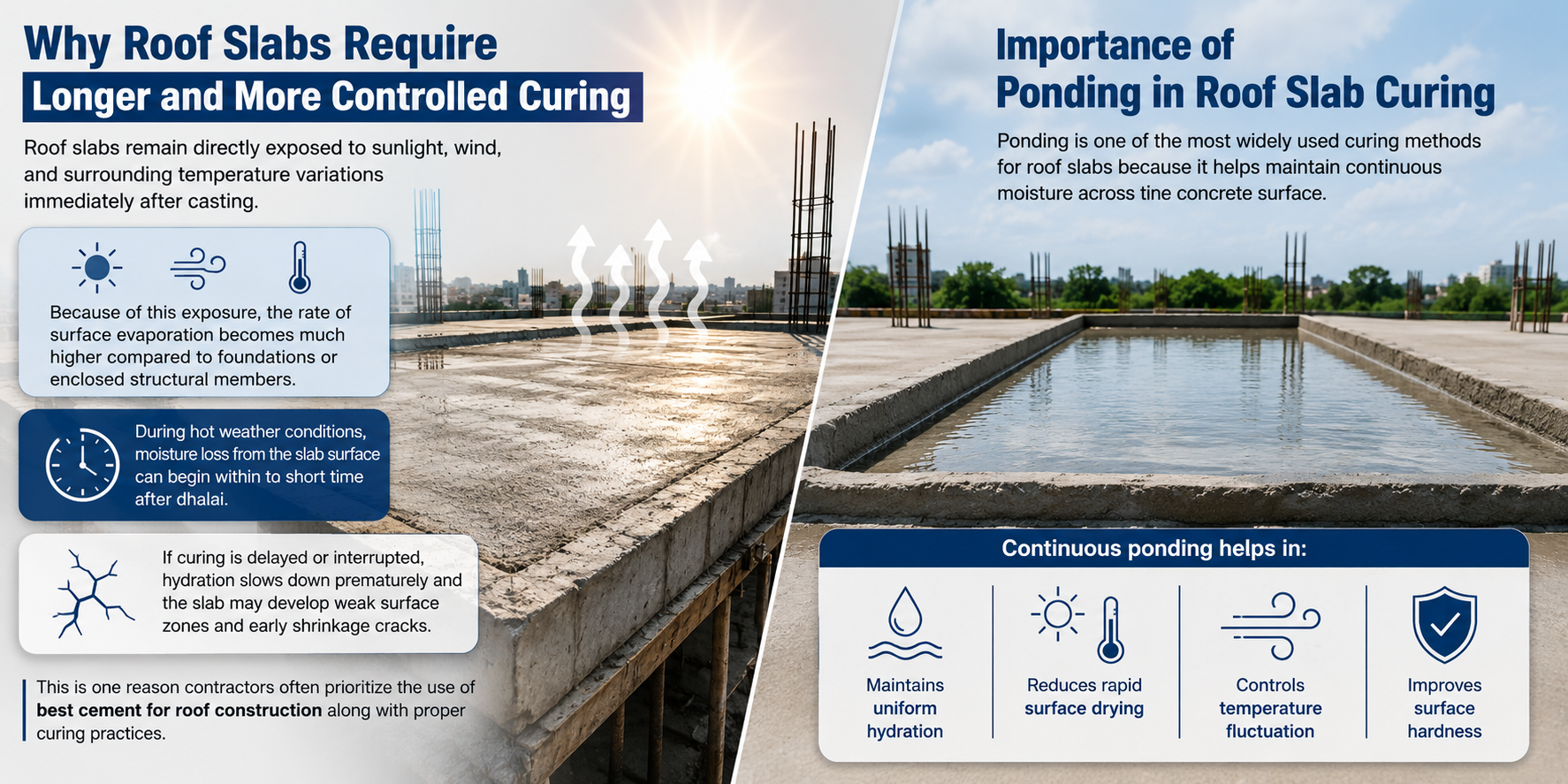
Roof slabs remain directly exposed to sunlight, wind, and surrounding temperature variations immediately after casting. Because of this exposure, the rate of surface evaporation becomes much higher compared to foundations or enclosed structural members.
During hot weather conditions, moisture loss from the slab surface can begin within a short time after dhalai. If curing is delayed or interrupted, hydration slows down prematurely and the slab may develop weak surface zones and early shrinkage cracks.
This is one reason contractors often prioritize the use of the best cement for roof construction along with proper curing practices.
Importance of Ponding in Roof Slab Curing
Ponding is one of the most widely used curing methods for roof slabs because it helps maintain continuous moisture across the concrete surface. In this method, temporary boundaries are created on the slab surface to retain a shallow layer of water for several days.
Continuous ponding:
- Maintains uniform hydration
- Reduces rapid surface drying
- Controls temperature fluctuation
- Improves surface hardness
Common Curing Mistakes That Hamper Concrete Quality
Even when good-quality materials and proper concrete mix proportions are used, poor curing practices can affect the final strength and durability of the structure. On many construction sites, curing mistakes occur because the process receives less attention after the main dhalai work is completed.
Stopping Curing Too Early
One of the most common mistakes is stopping curing within a few days after casting. The concrete surface may appear hard from the outside, but internally the hydration process is still continuing.
If curing is discontinued too early, the concrete may not develop its intended strength properly. In roof slabs and exposed RCC surfaces, this often increases the chances of surface cracks, seepage, and long-term durability problems.
Irregular Water Application
Concrete requires continuous moisture during the curing period. However, on many sites, water application becomes inconsistent after the initial few days. In some cases, curing is skipped during weekends or non-working hours.
This repeated cycle of drying and wetting affects hydration continuity and may result in uneven strength development within the concrete structure.
Neglecting Columns and Vertical Surfaces
Walls, columns, and other vertical RCC members are often not cured properly because maintaining moisture on vertical surfaces requires additional effort. However, these members can lose moisture rapidly due to wind exposure and surrounding temperature conditions.
Insufficient curing on vertical surfaces may lead to weaker surface strength and reduced durability over time.
Delayed Start of Curing
The timing of curing is also important. If curing begins too late after dhalai, the concrete surface may already lose a considerable amount of moisture.
Early drying increases shrinkage stress within the concrete and affects surface quality during the initial strength development stage.
Final Thoughts
In concrete construction, the work does not end after dhalai is completed. The days that follow are equally important because that is when the concrete gradually develops its actual strength. Proper curing gives the concrete the moisture and time required for hydration to continue properly, helping the structure become denser, stronger, and more durable over time.
Even when contractors use reliable dhalai cement and select the best cement for roof construction, the structure may still underperform if curing is neglected.
Therefore contractors, builders, and site engineers should never treat curing as a routine post-construction activity. It is one of the most important stages in concrete work and plays a major role in determining how well the structure performs in the long run.
FAQs:
1. How long should contractors continue curing after dhalai?
Contractors usually continue curing for at least 7 days in standard RCC work. In roof slabs, hot weather conditions, and blended cement applications, they often extend the curing process to 10–14 days for improved strength and durability.
2. Can improper curing reduce concrete strength?
Yes. When concrete loses moisture too early, hydration slows down before the structure develops proper internal bonding. This reduces compressive strength and increases the risk of cracks and durability issues.
3. Does the best cement for dhalai remove the need for curing?
No. Even the best cement for dhalai requires proper curing because cement develops strength only when hydration continues under adequate moisture conditions.
4. Which curing method do contractors commonly use for roof slabs?
Contractors commonly use ponding for roof slab curing. This method keeps water continuously on the slab surface and helps the concrete develop strength more uniformly.
5. Why do some concrete surfaces become powdery after construction?
Powdery or dusty concrete surfaces often indicate poor surface strength development. In many cases, inadequate curing, rapid moisture loss, or excess water in the concrete mix causes this problem.
Latest Posts


Popular Tags
- 43 Grade Cement
- 53 Grade Cement
- best cement
- best cement for construction
- best cement for dhalai
- Best Cement for House Construction
- best cement for plaster
- Best Cement for Plastering
- best cement for roof
- Best Cement for Roof Slab
- Best cement in Assam
- Cement factories in Assam
- cement shelf life
- cement storage during monsoon
- cement storage tips
- dhalai cement
- OPC 53 Grade
- OPC Cement
- OPC vs PPC Cement
- PPC Cement
- types of cement


