


26 Jun 2026

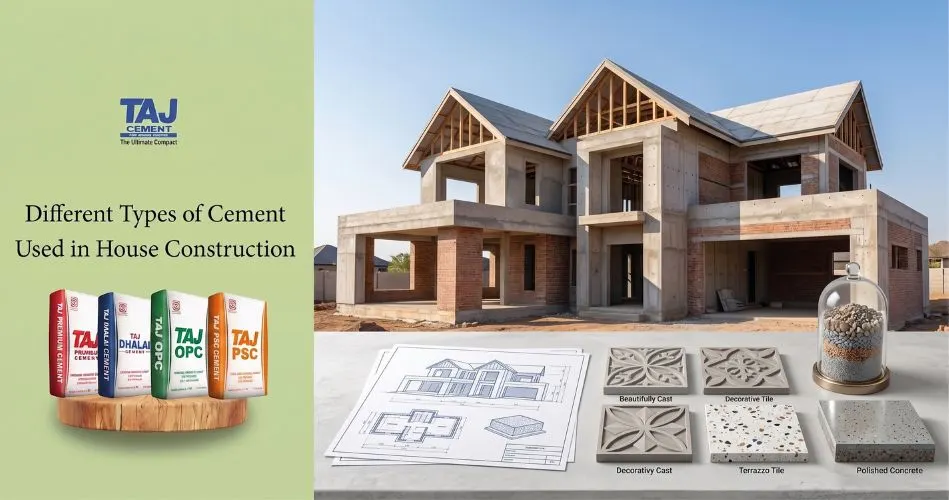
Not all cement is the same. Different parts of your house need different types — OPC for columns and slabs, PPC for plastering and brickwork, PSC for basements and wet areas. Picking the right cement keeps your home strong and crack-free for decades.
A Complete Technical Guide for Homeowners and Engineers in India
In many residential projects, cement selection happens within minutes. A contractor calls the supplier, compares a couple of brands, and places the order based on price or availability. It feels routine — and for years, this approach has been the norm across Indian construction sites.
But cement is not a one-size-fits-all material.
Different areas of a house experience different structural loads, moisture exposure, chemical environments, and thermal conditions. The cement best suited for a roof slab behaves differently than the cement required for basement waterproofing. The cement that performs reliably in the dry plains of Rajasthan may deteriorate rapidly in the coastal humidity of West Bengal or Odisha.
This guide covers every cement type relevant to residential construction in India — along with grades, properties, IS code references, application tables, and region-based recommendations — so you can make informed decisions before your project begins rather than after problems appear.
Why Cement Choice Makes or Breaks Your Home
Poor cement selection rarely causes dramatic, immediate failure. The consequences are gradual: hairline cracks appearing on plastered walls six months after construction, spalling concrete on exposed sunshades after a monsoon season, reinforcement corrosion beginning inside columns located near the sea.
By the time these problems become visible, rectification is expensive and sometimes structurally complex.
The right cement choice, made at the procurement stage, prevents all of this. Here is why:
- Structural RCC members (columns, beams, slabs, foundations) require controlled heat of hydration, reliable strength gain, and strong bonding with reinforcement steel.
- Masonry and plastering applications demand fine particle distribution, better workability, reduced shrinkage, and a smoother finishing surface.
- Moisture-exposed zones (basements, sunken bathrooms, water tanks, coastal structures) require cement with low permeability and chemical resistance.
- Large volume concrete pours (raft foundations, retaining walls) need cement that generates less heat during hydration to prevent internal thermal cracking.
The IS codes — IS 269, IS 1489, IS 455, IS 8041 — define the composition, strength, and performance requirements for each cement type. Understanding these gives both engineers and homeowners a technical baseline for procurement decisions.
The Different types of Cement and Their Uses in House Construction
1. Ordinary Portland Cement (OPC)
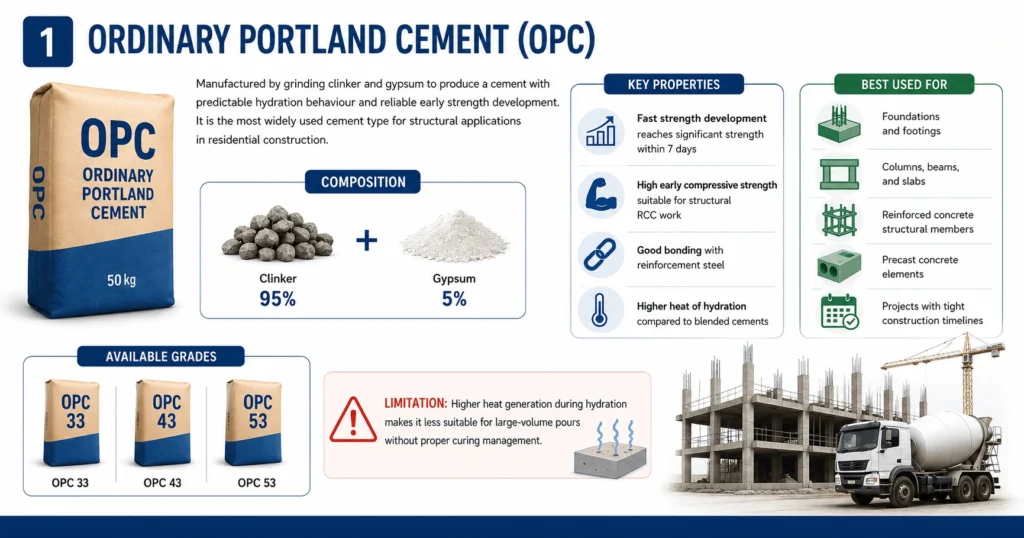
Ordinary Portland Cement is manufactured by grinding clinker and gypsum to produce a cement with predictable hydration behaviour and reliable early strength development. It is the most widely used cement type for structural applications in residential construction.
Composition: Clinker (95%) + Gypsum (5%)
Key properties:
- Fast strength development — reaches significant strength within 7 days
- High early compressive strength suitable for structural RCC work
- Good bonding with reinforcement steel
- Higher heat of hydration compared to blended cements
Best used for:
- Foundations and footings
- Columns, beams, and slabs
- Reinforced concrete structural members
- Precast concrete elements
- Projects with tight construction timelines
Available grades: OPC 33, OPC 43, OPC 53
Limitation: Higher heat generation during hydration makes it less suitable for large-volume pours without proper curing management.
2. Portland Pozzolana Cement (PPC)
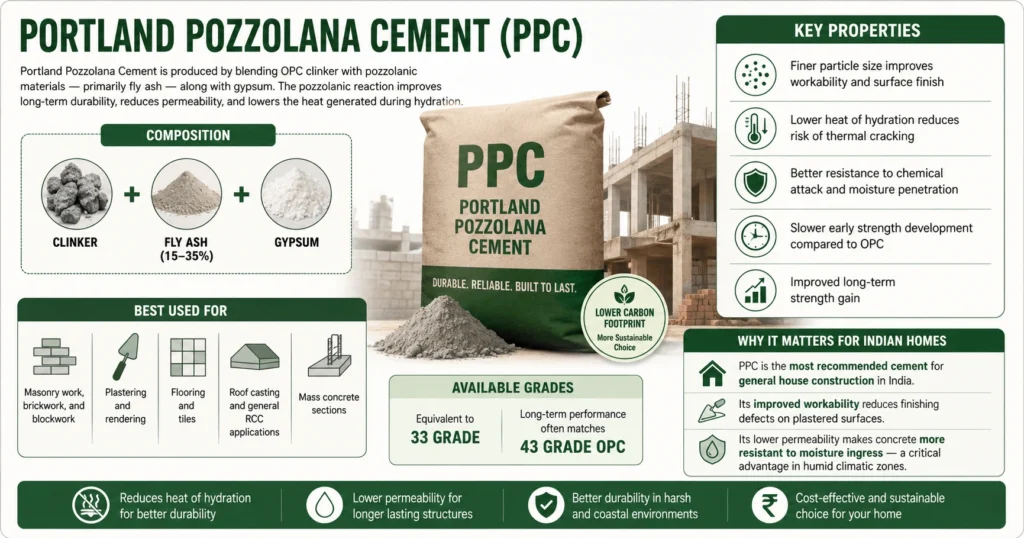
Portland Pozzolana Cement is produced by blending OPC clinker with pozzolanic materials — primarily fly ash — along with gypsum. The pozzolanic reaction improves long-term durability, reduces permeability, and lowers the heat generated during hydration.
Composition: Clinker + Fly Ash (15–35%) + Gypsum
Key properties:
- Finer particle size improves workability and surface finish
- Lower heat of hydration reduces risk of thermal cracking
- Better resistance to chemical attack and moisture penetration
- Slower early strength development compared to OPC
- Improved long-term strength gain
Best used for:
- Masonry work, brickwork, and blockwork
- Plastering and rendering
- Flooring and tiles
- Roof casting and general RCC applications
- Mass concrete sections
Available grades: Equivalent to 33 Grade; long-term performance often matches 43 Grade OPC
Why it matters for Indian homes: PPC is the most recommended cement for general house construction in India. Its improved workability reduces finishing defects on plastered surfaces, and its lower permeability makes concrete more resistant to moisture ingress — a critical advantage in humid climatic zones.
3. Portland Slag Cement (PSC)
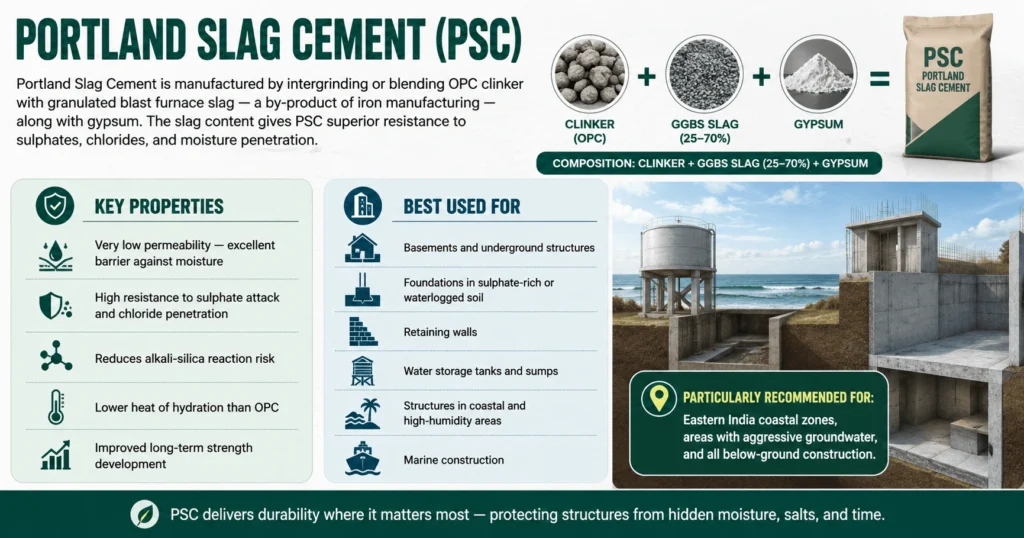
Portland Slag Cement is manufactured by intergrinding or blending OPC clinker with granulated blast furnace slag — a by-product of iron manufacturing — along with gypsum. The slag content gives PSC superior resistance to sulphates, chlorides, and moisture penetration.
Composition: Clinker + GGBS Slag (25–70%) + Gypsum
Key properties:
- Very low permeability — excellent barrier against moisture
- High resistance to sulphate attack and chloride penetration
- Reduces alkali-silica reaction risk
- Lower heat of hydration than OPC
- Improved long-term strength development
Best used for:
- Basements and underground structures
- Foundations in sulphate-rich or waterlogged soil
- Retaining walls
- Water storage tanks and sumps
- Structures in coastal and high-humidity areas
- Marine construction
Particularly recommended for: Eastern India coastal zones, areas with aggressive groundwater, and all below-ground construction.
4. Dhalai Cement
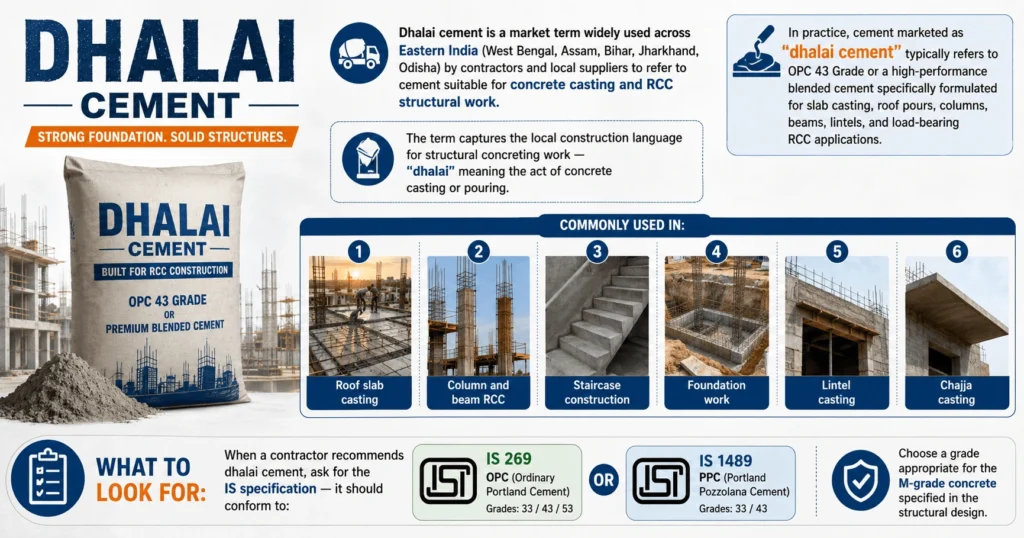
Dhalai cement is not a technical IS classification — it is a market term widely used across Eastern India (West Bengal, Assam, Bihar, Jharkhand, Odisha) by contractors and local suppliers to refer to cement suitable for concrete casting and RCC structural work.
In practice, cement marketed as “dhalai cement” typically refers to OPC 43 Grade or a high-performance blended cement specifically formulated for slab casting, roof pours, columns, beams, lintels, and load-bearing RCC applications.
The term captures the local construction language for structural concreting work — “dhalai” meaning the act of concrete casting or pouring.
Commonly used in:
- Roof slab casting
- Column and beam RCC
- Staircase construction
- Foundation work
- Lintel and chajja casting
What to look for: When a contractor recommends dhalai cement, ask for the IS specification — it should conform to IS 269 (OPC) or IS 1489 (PPC) with a grade appropriate for the M-grade concrete specified in the structural design.
5. Sulphate Resisting Cement (SRC)
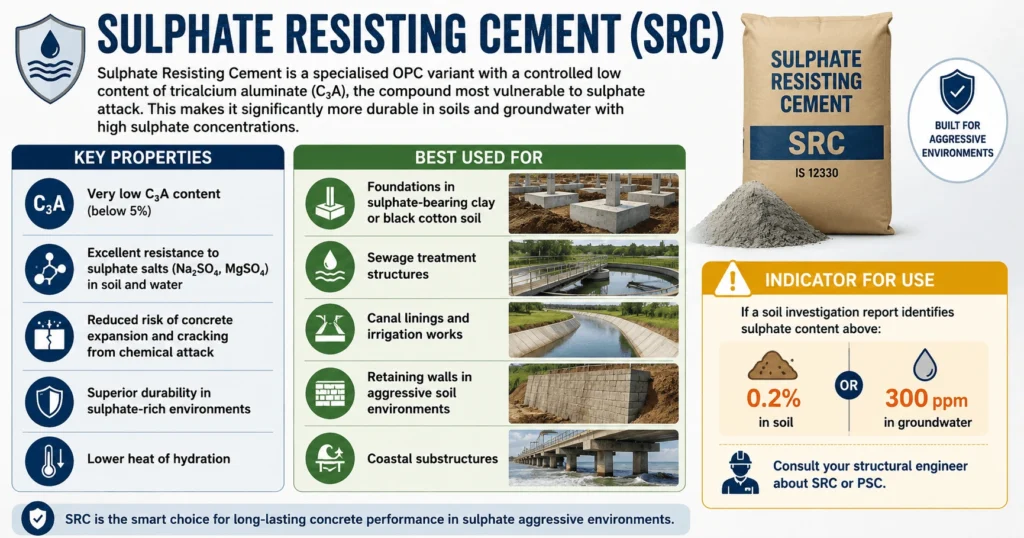
Sulphate Resisting Cement is a specialised OPC variant with a controlled low content of tricalcium aluminate (C3A), the compound most vulnerable to sulphate attack. This makes it significantly more durable in soils and groundwater with high sulphate concentrations.
Key properties:
- Very low C3A content (below 5%)
- Excellent resistance to sulphate salts (Na2SO4, MgSO4) in soil and water
- Reduced risk of concrete expansion and cracking from chemical attack
- Lower heat of hydration
Best used for:
- Foundations in sulphate-bearing clay or black cotton soil
- Sewage treatment structures
- Canal linings and irrigation works
- Retaining walls in aggressive soil environments
- Coastal substructures
Indicator for use: If a soil investigation report identifies sulphate content above 0.2% in soil or 300 ppm in groundwater, consult your structural engineer about SRC or PSC.
6. Rapid Hardening Cement (RHC)
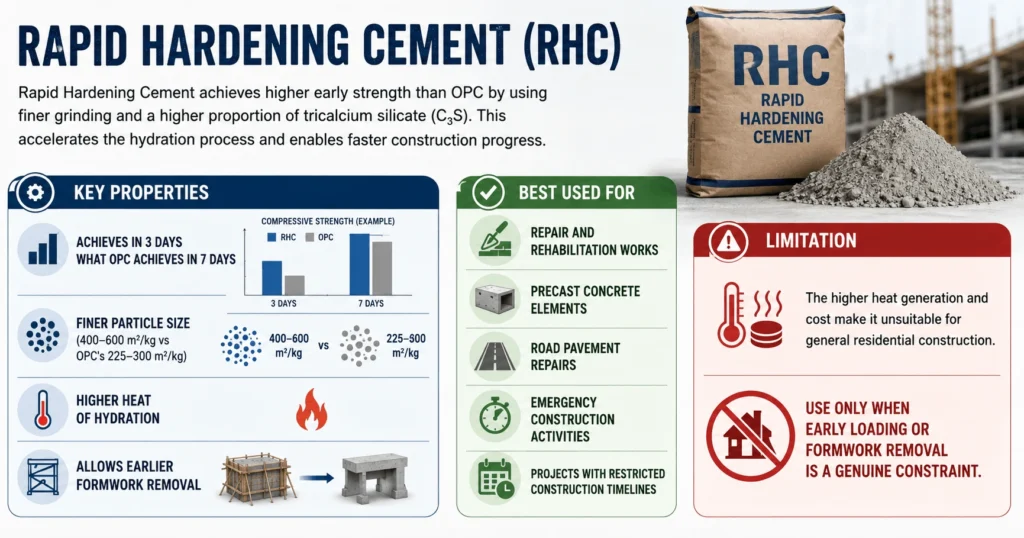
Rapid Hardening Cement achieves higher early strength than OPC by using finer grinding and a higher proportion of tricalcium silicate (C3S). This accelerates the hydration process and enables faster construction progress.
Key properties:
- Achieves in 3 days what OPC achieves in 7 days
- Finer particle size (400–600 m²/kg vs OPC’s 225–300 m²/kg)
- Higher heat of hydration
- Allows earlier formwork removal
Best used for:
- Repair and rehabilitation works
- Precast concrete elements
- Road pavement repairs
- Emergency construction activities
- Projects with restricted construction timelines
Limitation: The higher heat generation and cost make it unsuitable for general residential construction. Use only when early loading or formwork removal is a genuine constraint.
7. Quick Setting Cement
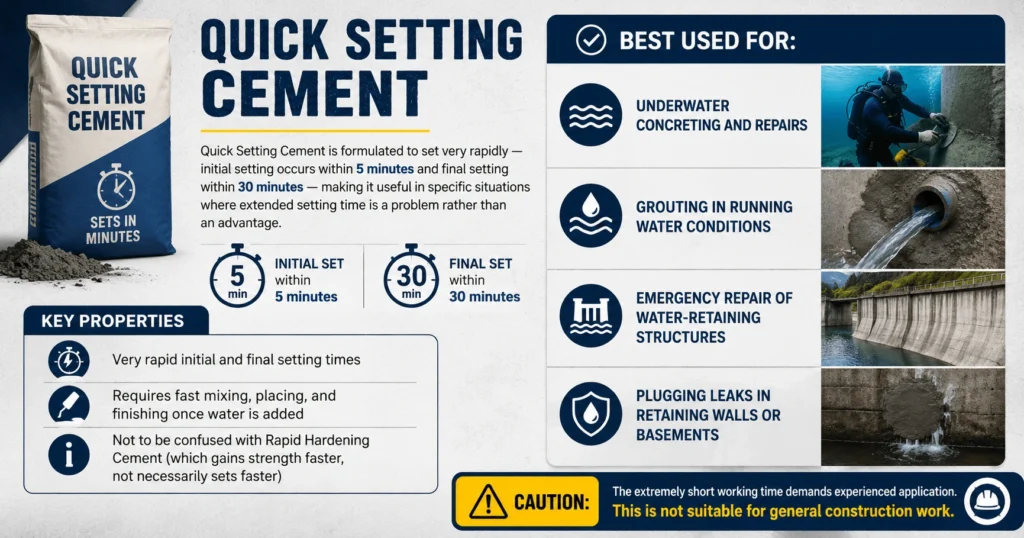
Quick Setting Cement is formulated to set very rapidly — initial setting occurs within 5 minutes and final setting within 30 minutes — making it useful in specific situations where extended setting time is a problem rather than an advantage.
Key properties:
- Very rapid initial and final setting times
- Requires fast mixing, placing, and finishing once water is added
- Not to be confused with Rapid Hardening Cement (which gains strength faster, not necessarily sets faster)
Best used for:
- Underwater concreting and repairs
- Grouting in running water conditions
- Emergency repair of water-retaining structures
- Plugging leaks in retaining walls or basements
Caution: The extremely short working time demands experienced application. This is not suitable for general construction work.
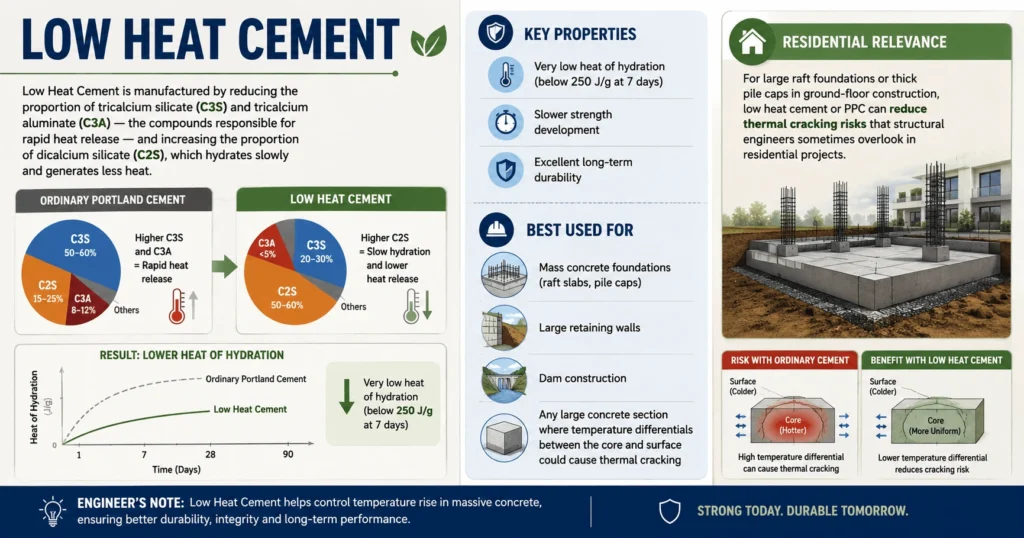
8. Low Heat Cement
Low Heat Cement is manufactured by reducing the proportion of tricalcium silicate (C3S) and tricalcium aluminate (C3A) — the compounds responsible for rapid heat release — and increasing the proportion of dicalcium silicate (C2S), which hydrates slowly and generates less heat.
Key properties:
- Very low heat of hydration (below 250 J/g at 7 days)
- Slower strength development
- Excellent long-term durability
Best used for:
- Mass concrete foundations (raft slabs, pile caps)
- Large retaining walls
- Dam construction
- Any large concrete section where temperature differentials between the core and surface could cause thermal cracking
Residential relevance: For large raft foundations or thick pile caps in ground-floor construction, low heat cement or PPC can reduce thermal cracking risks that structural engineers sometimes overlook in residential projects.
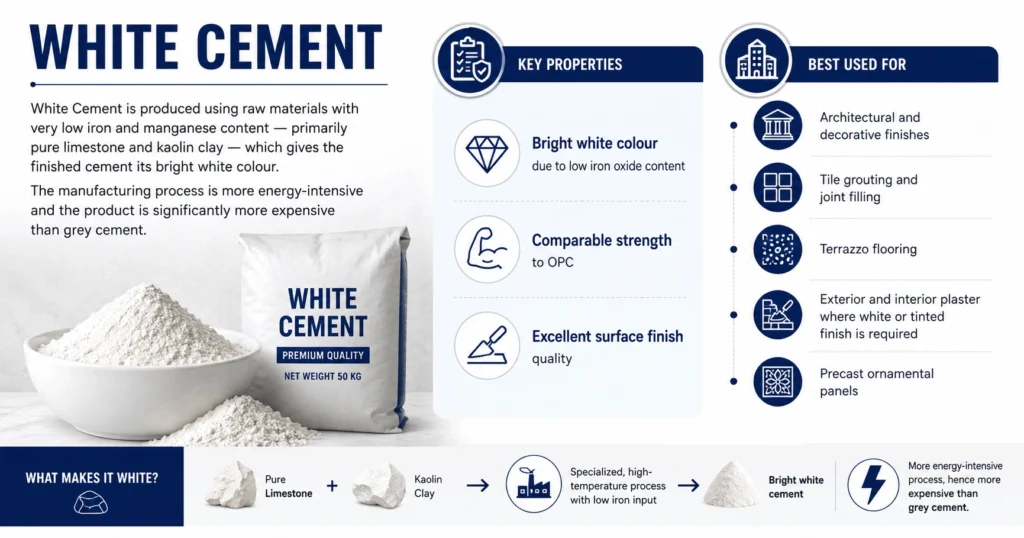
9. White Cement
White Cement is produced using raw materials with very low iron and manganese content — primarily pure limestone and kaolin clay — which gives the finished cement its bright white colour. The manufacturing process is more energy-intensive and the product is significantly more expensive than grey cement.
Key properties:
- Bright white colour due to low iron oxide content
- Comparable strength to OPC
- Excellent surface finish quality
Best used for:
- Architectural and decorative finishes
- Tile grouting and joint filling
- Terrazzo flooring
- Exterior and interior plaster where white or tinted finish is required
- Precast ornamental panels
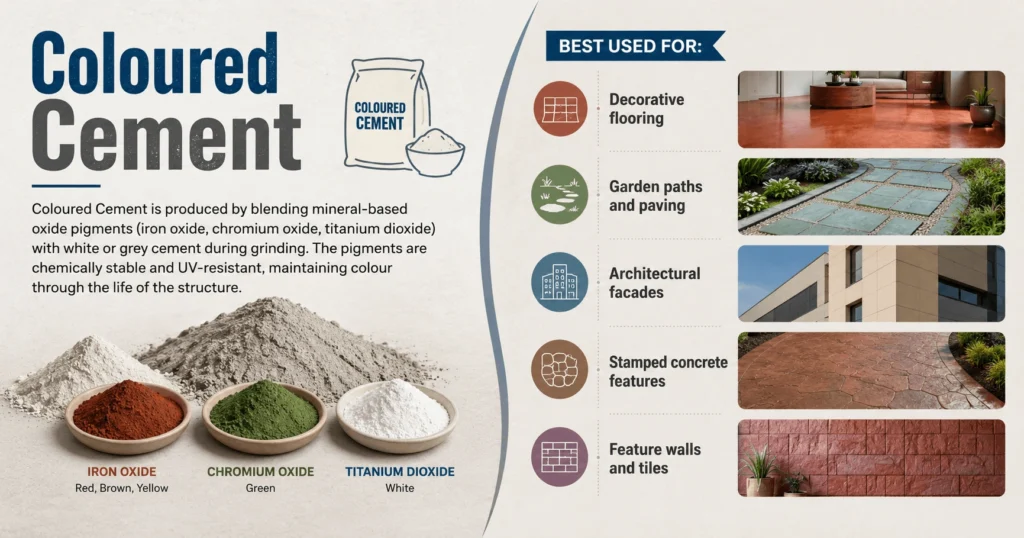
10. Coloured Cement
Coloured Cement is produced by blending mineral-based oxide pigments (iron oxide, chromium oxide, titanium dioxide) with white or grey cement during grinding. The pigments are chemically stable and UV-resistant, maintaining colour through the life of the structure.
Best used for:
- Decorative flooring
- Garden paths and paving
- Architectural facades
- Stamped concrete features
- Feature walls and tiles
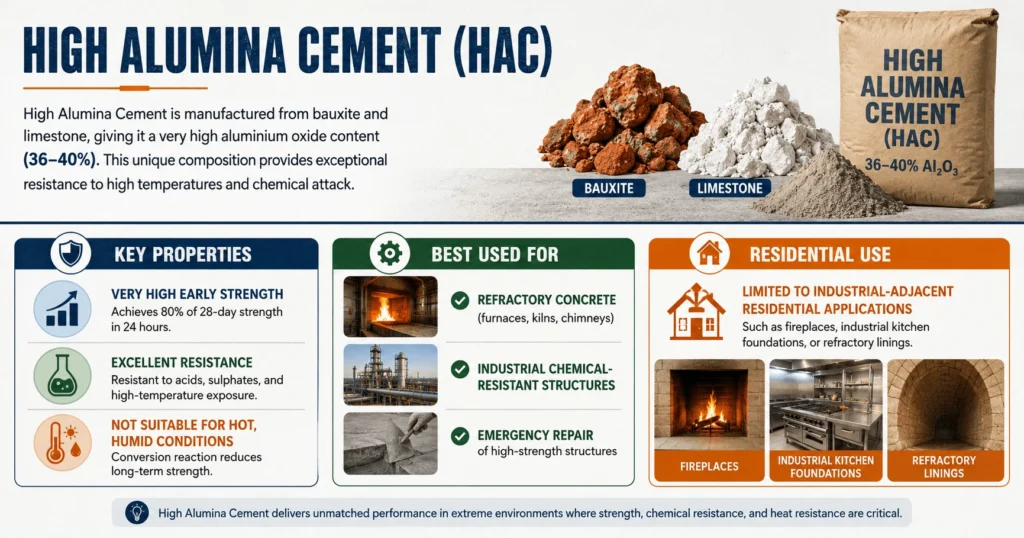
11. High Alumina Cement (HAC)
High Alumina Cement is manufactured from bauxite and limestone, giving it a very high aluminium oxide content (36–40%). This unique composition provides exceptional resistance to high temperatures and chemical attack.
Key properties:
- Very high early strength (achieves 80% of 28-day strength in 24 hours)
- Excellent resistance to acids, sulphates, and high-temperature exposure
- Not suitable for use in hot, humid conditions (conversion reaction reduces long-term strength)
Best used for:
- Refractory concrete (furnaces, kilns, chimneys)
- Industrial chemical-resistant structures
- Emergency repair of high-strength structures
Residential use: Limited to industrial-adjacent residential applications such as fireplaces, industrial kitchen foundations, or refractory linings.
12. Air Entraining Cement
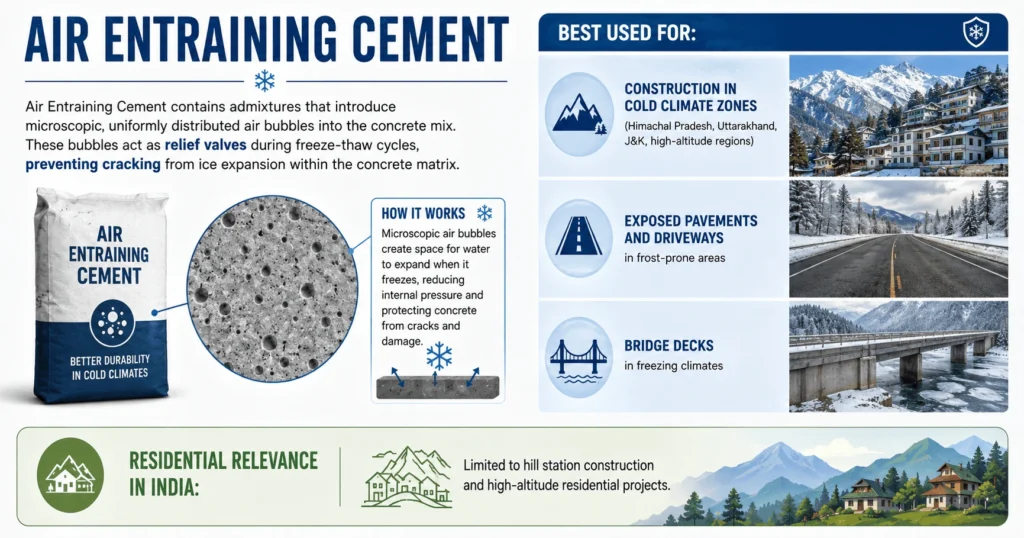
Air Entraining Cement contains admixtures that introduce microscopic, uniformly distributed air bubbles into the concrete mix. These bubbles act as relief valves during freeze-thaw cycles, preventing cracking from ice expansion within the concrete matrix.
Best used for:
- Construction in cold climate zones (Himachal Pradesh, Uttarakhand, J&K, high-altitude regions)
- Exposed pavements and driveways in frost-prone areas
- Bridge decks in freezing climates
Residential relevance in India: Limited to hill station construction and high-altitude residential projects.
13. Expansive Cement
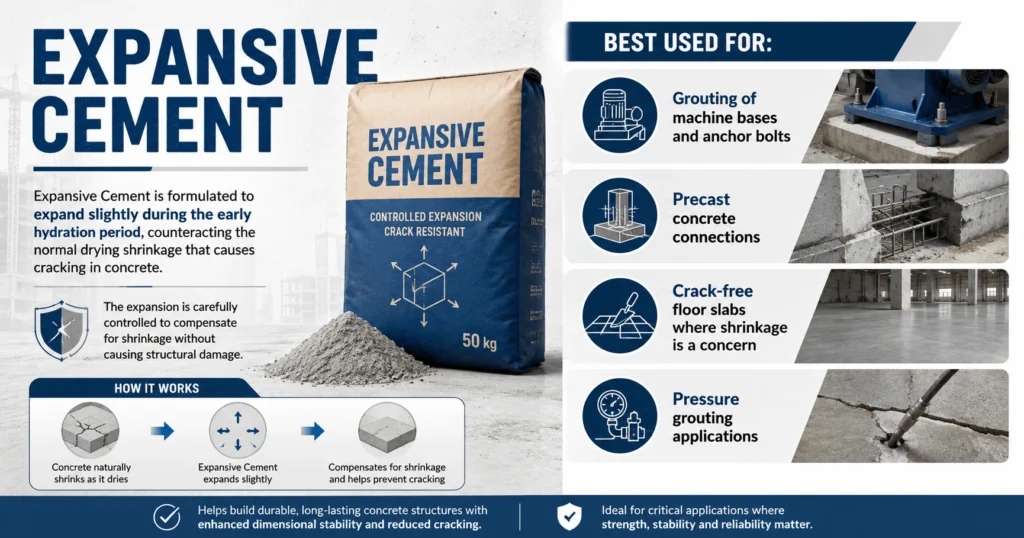
Expansive Cement is formulated to expand slightly during the early hydration period, counteracting the normal drying shrinkage that causes cracking in concrete. The expansion is carefully controlled to compensate for shrinkage without causing structural damage.
Best used for:
- Grouting of machine bases and anchor bolts
- Precast concrete connections
- Crack-free floor slabs where shrinkage is a concern
- Pressure grouting applications
14. Hydrographic Cement (Hydrophobic Cement)
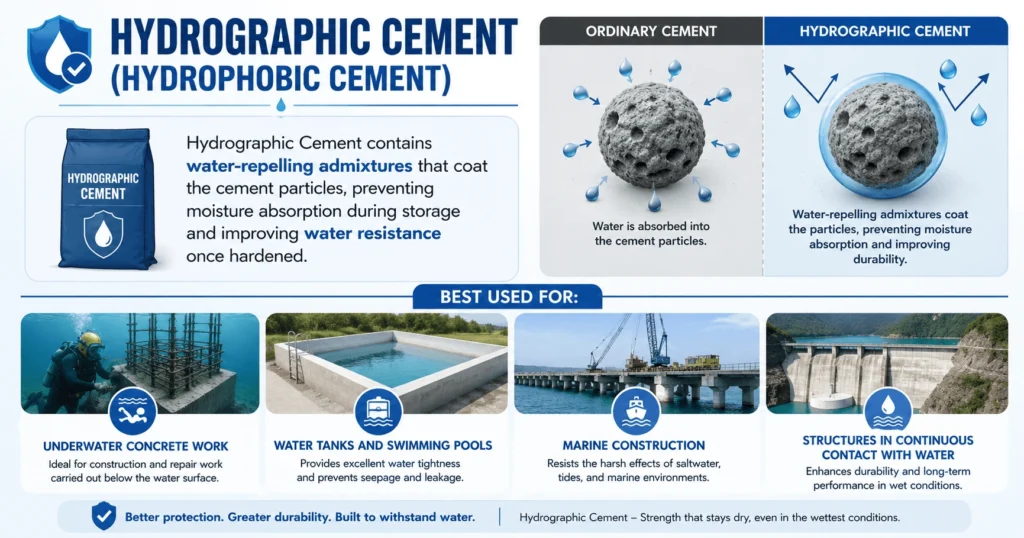
Hydrographic Cement contains water-repelling admixtures that coat the cement particles, preventing moisture absorption during storage and improving water resistance once hardened.
Best used for:
- Underwater concrete work
- Water tanks and swimming pools
- Marine construction
- Structures in continuous contact with water
Cement Grades Explained
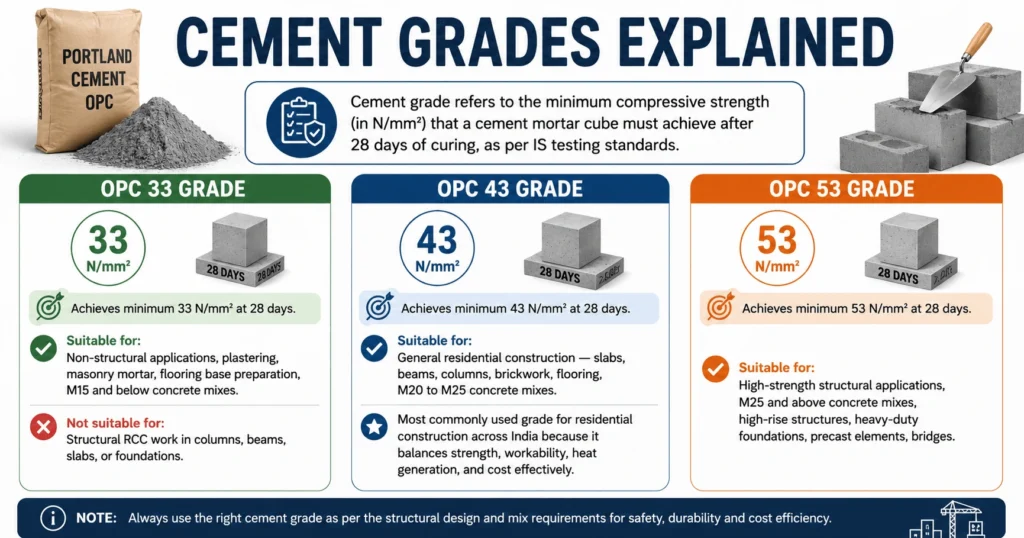
Cement grade refers to the minimum compressive strength (in N/mm²) that a cement mortar cube must achieve after 28 days of curing, as per IS testing standards.
OPC 33 Grade
Achieves minimum 33 N/mm² at 28 days.
Suitable for: Non-structural applications, plastering, masonry mortar, flooring base preparation, M15 and below concrete mixes.
Not suitable for: Structural RCC work in columns, beams, slabs, or foundations.
OPC 43 Grade
Achieves minimum 43 N/mm² at 28 days.
Suitable for: General residential construction — slabs, beams, columns, brickwork, flooring, M20 to M25 concrete mixes.
Most commonly used grade for residential construction across India because it balances strength, workability, heat generation, and cost effectively.
OPC 53 Grade
Achieves minimum 53 N/mm² at 28 days.
Suitable for: High-strength structural applications, M25 and above concrete mixes, high-rise structures, heavy-duty foundations, precast elements, bridges.
Important note: 53 Grade generates significantly more heat during hydration than 43 Grade. Without careful curing management, this higher heat can cause thermal micro-cracking — meaning a higher-grade cement without proper curing may actually produce weaker, more porous concrete than correctly cured 43 Grade.
Key Cement Properties Every Homeowner Should Understand
Understanding cement properties helps you ask the right questions at procurement and verify quality on site.
Fineness
Fineness refers to the particle size of ground cement, measured in m²/kg (specific surface area). Finer cement hydrates faster, develops early strength quicker, and produces better workability — but may generate more heat.
OPC 53 Grade is finer than OPC 43 Grade, which is finer than OPC 33 Grade.
Setting Time
Setting time describes how long cement paste takes to transition from a plastic, workable state to a rigid solid.
- Initial setting time: The point at which the paste starts to stiffen. No further mixing, placing, or finishing should happen after this point.
- Final setting time: The point at which the cement paste has hardened sufficiently.
As per IS standards, OPC must have an initial setting time of at least 30 minutes and a final setting time of no more than 600 minutes. Adequate setting time allows concrete to be transported, placed, vibrated, and finished.
Soundness
A cement is called “sound” if it does not undergo excessive expansion after hardening. Unsound cement expands and cracks after setting, compromising the structure from within. Soundness is tested using the Le Chatelier test or autoclave test.
On-site check: Fresh cement stored in dry conditions is generally sound. Lumpy, pre-hydrated cement bags must be rejected.
Compressive Strength
This is the load-bearing capacity of hardened cement paste or mortar, tested at 3, 7, and 28 days. The 28-day value is the basis for grade classification. Concrete design mixes are based on 28-day characteristic compressive strength.
Heat of Hydration
All cement types generate heat when they react with water — this is called heat of hydration. In thin concrete sections, this heat dissipates without damage. In large sections (thick slabs, raft foundations, retaining walls), excessive heat buildup creates a temperature differential between the hot interior and cooler surface, causing thermal cracking.
Lower heat of hydration: PPC, PSC, Low Heat Cement Higher heat of hydration: OPC (especially 53 Grade), Rapid Hardening Cement
Consistency
Standard consistency measures the amount of water required to bring cement paste to a workable state. This measurement helps determine the correct water-cement ratio for a specific cement batch — critical for achieving the designed concrete strength.
Loss on Ignition (LOI)
LOI refers to the weight loss in cement when heated to high temperatures. High LOI indicates that cement has absorbed moisture or carbonated during storage, compromising its quality. This is a common issue with old cement bags stored in humid conditions.
Quick Reference: Cement Type vs Application vs Recommended Grade
| Application | Recommended Cement Type | Recommended Grade |
| Columns, beams, structural RCC | OPC or PPC | 43 or 53 Grade |
| Roof slab casting (dhalai) | OPC or PPC | 43 Grade |
| Foundations (general) | OPC or PPC | 43 Grade |
| Foundations (sulphate soil) | PSC or SRC | 43 Grade equivalent |
| Basement / underground | PSC or SRC | 43 Grade equivalent |
| Plastering | PPC | 33 or 43 Grade |
| Brickwork / masonry | PPC | 33 or 43 Grade |
| Flooring | PPC | 43 Grade |
| Water tanks / sumps | PSC or Hydrographic Cement | 43 Grade |
| Repairs / urgent work | Rapid Hardening Cement | 43/53 equivalent |
| Decorative / architectural | White or Coloured Cement | As specified |
| Mass concrete foundations | Low Heat or PPC | 43 Grade |
| Coastal / marine structures | PSC or SRC | 43 Grade equivalent |
Region-Based Cement Recommendations for India
Indian climatic and soil conditions vary significantly across regions. The same cement selection approach used in Delhi cannot be applied to a project in coastal Odisha or high-altitude Shimla.
Eastern India (West Bengal, Odisha, Assam, Bihar, Jharkhand)
High humidity, heavy monsoon rainfall, and coastal proximity in many areas make moisture resistance a primary consideration.
- Recommended for general construction: PPC (IS 1489)
- Recommended for foundations and basements: PSC (IS 455)
- Recommended for structural RCC: OPC 43 Grade or PPC
- Avoid: OPC 53 Grade for plastering or masonry work
Coastal Regions (West Bengal coast, Odisha, Kerala, Tamil Nadu, Maharashtra coast, Goa)
Chloride-rich air and seawater exposure accelerate reinforcement corrosion in conventional concrete.
- Recommended for all substructure work: PSC or SRC
- Recommended for superstructure: PPC with low water-cement ratio
- Recommended for exposed RCC (sunshades, balconies): PSC
Dry and Semi-Arid Regions (Rajasthan, Gujarat, parts of Maharashtra)
Lower humidity reduces the risk of moisture-related deterioration but sulphate-bearing soils are common.
- Recommended for foundations: SRC or PSC if soil test confirms sulphate presence
- Recommended for superstructure: OPC 43 or PPC
Cold and High-Altitude Regions (Himachal Pradesh, Uttarakhand, J&K, NE Hill States)
Freeze-thaw cycles, low temperatures, and delayed curing are primary concerns.
- Recommended: Air Entraining Cement or OPC 43 with air-entraining admixtures
- For fast construction in low temperatures: Rapid Hardening Cement
Black Cotton Soil Zones (Vidarbha, Marathwada, central India)
Black cotton (expansive) soil causes foundation movement. Sulphate and chemical attack are additional risks.
- Recommended for foundations: SRC or PSC
- Deeper foundations with thick RCC: Low Heat Cement or PPC for raft slabs
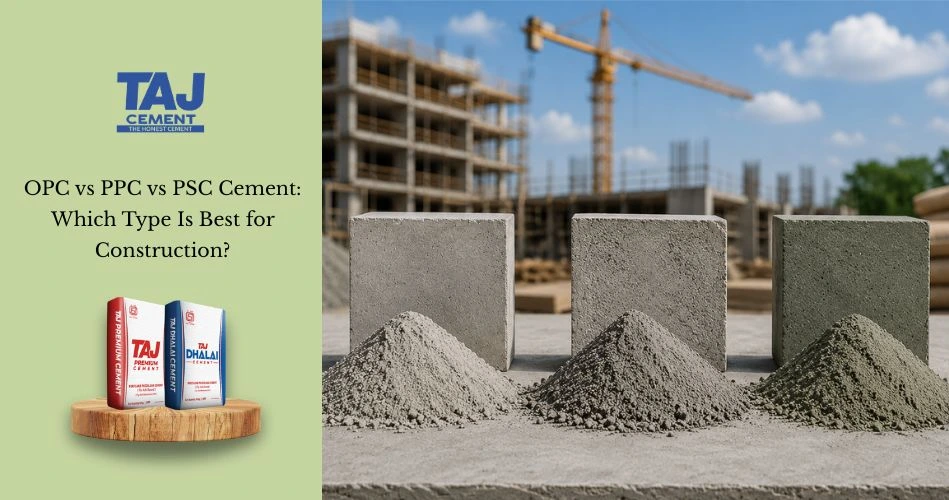
OPC vs PPC: Which Is Better for Your House?
This is one of the most common questions from homeowners and contractors across India. The answer depends on the application.
| Parameter | OPC | PPC |
| Early strength gain | Faster | Slower |
| 28-day strength | High | Comparable to OPC |
| Long-term strength | Good | Better (pozzolanic reaction continues) |
| Heat of hydration | Higher | Lower |
| Workability | Moderate | Better (finer particles) |
| Surface finish (plaster) | Adequate | Superior |
| Permeability | Moderate | Lower |
| Durability in aggressive environment | Moderate | Better |
| Eco-friendliness | Standard | Better (uses fly ash) |
| Cost | Slightly higher | Slightly lower |
Verdict for residential construction:
- For structural RCC (columns, beams, slabs): Either OPC 43 or PPC works; use OPC 43 when faster formwork removal is needed.
- For plastering, brickwork, and finishes: PPC is clearly superior.
- For foundations in moisture-exposed or chemically aggressive soil: PSC or SRC.
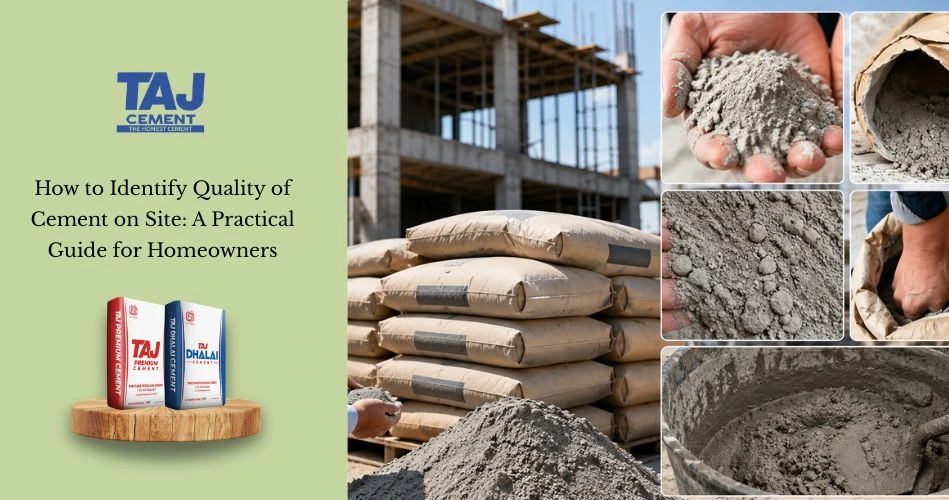
How to Check Cement Quality Before Use
Construction quality begins at procurement. These on-site checks help identify poor or deteriorated cement before it reaches the mixer.
1. Manufacturing Date Check: Always check the date of manufacture printed on the bag. Cement loses strength progressively after manufacture — approximately 20% in 3 months, 30% in 6 months, 40% in 12 months. Never use cement older than 3 months without a fresh testing-based verification.
2. Colour Check: Fresh, quality cement should be uniformly grey — not too dark (excess ash) and not too light (excess lime). Colour variations within a bag batch suggest inconsistent manufacturing.
3. Touch and Feel Test: Insert your hand into the bag and feel the cement. Fresh cement should feel cool and smooth (the hydration reaction is exothermic — unused fresh cement still draws heat from your hand). Warm, lumpy cement indicates pre-hydration due to moisture exposure — reject it.
4. Float Test: Take a small pinch of cement and drop it on still water. Fresh, quality cement should float for a while before slowly sinking. Cement that sinks immediately may have poor quality or be old.
5. Paper Test: Place a small quantity of cement on a piece of paper and press it gently. Fresh cement should leave a cool sensation on the hand when the paper is removed. Old or heat-degraded cement will not.
6. Bag Condition: Inspect bags for moisture seepage marks, torn corners, or hardened lumps. Even partial pre-hydration reduces the effective binding capacity of cement significantly.
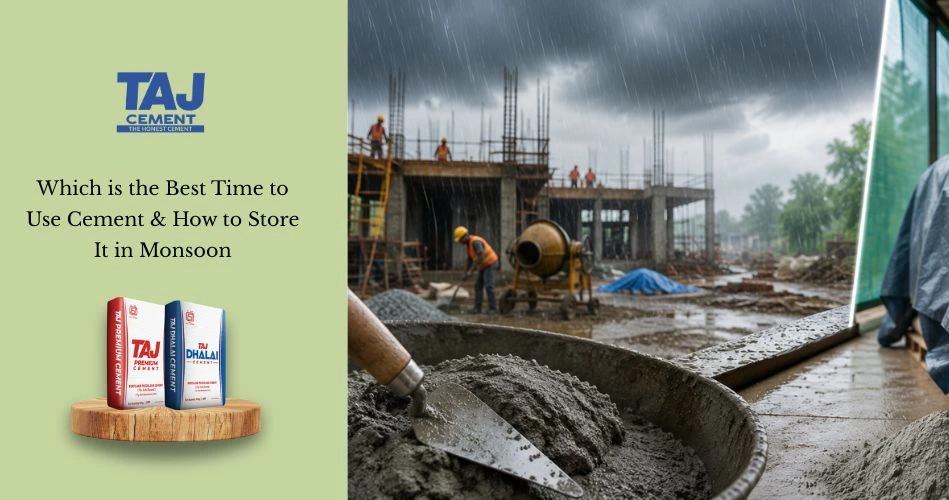
Cement Storage Guidelines for Site
Improper storage is one of the most common causes of cement quality deterioration on Indian construction sites.
- Store cement bags in a dry, weather-protected room with a raised wooden pallet floor (minimum 200mm above ground level).
- Stack bags no higher than 10 bags to prevent pressure-setting in lower bags.
- Maintain a minimum 300mm clearance from all walls to prevent moisture absorption.
- Use cement strictly on a First In, First Out (FIFO) basis — older bags must be used before newer stock.
- Never store cement in direct sunlight or in open areas.
- In monsoon conditions, cover stacked bags with polythene sheeting even inside storage.
Final Word
The selection of the right cement type and grade is a technical decision, not a routine procurement task. Every stage of house construction — structural RCC, masonry, plastering, waterproofing, finishing — places different demands on cement composition, hydration behaviour, and long-term durability performance.
Using the same cement for every purpose may simplify ordering, but it creates invisible vulnerabilities inside the structure that only reveal themselves years later — as cracks, moisture damage, or, in worst cases, compromised structural members.
Choose cement based on the application, the structural design requirements, the local soil and climate conditions, and the IS specifications that apply to your project. Verify freshness before use, store correctly, and ensure proper curing after placement.
Your home is a long-term investment. The cement decisions made before the first pour determine how it performs for the next fifty years.
FAQ
Which cement type is best for constructing a house in India?
For most residential applications, PPC (Portland Pozzolana Cement) as per IS 1489 is the most balanced choice — offering good workability, durability, lower heat generation, and better surface finish. For structural RCC work (columns, beams, slabs), OPC 43 Grade or PPC with 43 Grade equivalent strength is appropriate. For foundations and below-ground construction, PSC (Portland Slag Cement) offers superior protection against moisture and chemical attack.
What is the difference between OPC and PPC cement?
OPC gains strength faster and is better suited for structural RCC work where early strength is important. PPC gains strength more gradually but achieves better long-term durability, lower permeability, reduced heat of hydration, and superior surface finish — making it the preferred choice for plastering, masonry, and general residential construction.
What is dhalai cement, and which type should I use?
Dhalai cement is a local market term used across Eastern India for cement used in concrete casting — particularly roof slab and structural RCC work. It typically refers to OPC 43 Grade or a high-performance blended cement. Ask for the IS specification on the bag to confirm the grade and type.
Can I use 53 Grade cement for everything in my house?
Not necessarily. While 53 Grade cement develops higher compressive strength, it also generates more heat during hydration. For plastering and masonry, this creates unnecessary heat buildup and no strength benefit. For structural RCC, 53 Grade is appropriate when the structural design specifies M25 or higher concrete — but proper curing is essential to avoid thermal cracking.
Which cement is best for coastal regions in India?
Portland Slag Cement (PSC) as per IS 455 is the most recommended option for coastal construction. Its low permeability and high resistance to chloride penetration protect reinforcement steel from the accelerated corrosion that chloride-rich coastal environments cause in conventional OPC concrete.
How do I know if a cement bag is fresh?
Check the date of manufacture printed on the bag. The cement should ideally be used within 3 months of manufacturing. On site, perform a hand-feel test — fresh cement should feel cool and be free of lumps. Any sign of pre-hydration (hardened clumps, warm feel, moisture marks on the bag) is reason to reject the batch.
Why does my plastered wall develop cracks after a few months?
Common causes include use of OPC for plastering (instead of PPC, which shrinks less), excessive water-cement ratio during mixing, inadequate curing after plastering, or application in direct sunlight before the plaster sets. PPC’s finer particle size and reduced shrinkage behaviour make it significantly more crack-resistant for plastering applications.
What cement type should be used for a water tank or sump?
Portland Slag Cement (PSC) or Hydrographic Cement is recommended for water-retaining structures. PSC’s low permeability prevents seepage, while its resistance to chloride and sulphate attack protects the structure long-term. The water-cement ratio must be kept below 0.45, and proper curing for a minimum of 28 days is essential before filling.
Does higher-grade cement always produce stronger concrete?
No. Concrete strength depends on the water-cement ratio, aggregate quality, compaction, and curing practices — not just cement grade. A well-cured, properly compacted M20 mix using OPC 43 Grade will consistently outperform a poorly cured, inadequately compacted M25 mix using OPC 53 Grade. Grade defines potential strength; site practices determine actual strength.
Is PPC or PSC environmentally better than OPC?
Both PPC and PSC have a significantly lower carbon footprint than OPC because they replace a portion of clinker — the most energy-intensive and CO₂-intensive component of cement — with industrial by-products (fly ash in PPC, granulated blast furnace slag in PSC). Choosing PPC or PSC for appropriate applications in your house construction reduces both environmental impact and material cost.
Latest Posts

Popular Tags
- 43 Grade Cement
- 53 Grade Cement
- best cement
- best cement for construction
- best cement for dhalai
- Best Cement for House Construction
- best cement for plaster
- Best Cement for Plastering
- best cement for roof
- Best Cement for Roof Slab
- Best cement in Assam
- Cement factories in Assam
- cement shelf life
- cement storage during monsoon
- cement storage tips
- dhalai cement
- OPC 53 Grade
- OPC Cement
- OPC vs PPC Cement
- PPC Cement
- types of cement


